Table of Contents
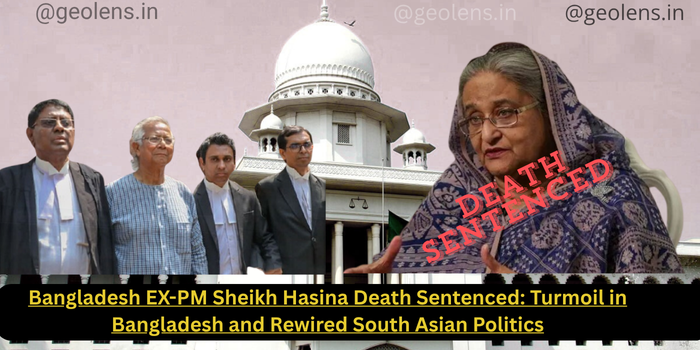
The controversy surrounding Sheikh Hasina death sentenced has triggered one of the most turbulent moments in Bangladesh’s modern political history. The International Crimes Tribunal handed the former prime minister a death sentence in absentia for her alleged role in the 2024 student protest crackdown, a period marked by severe violence and over a thousand reported deaths.
The ruling has overturned the country’s political equilibrium, leading to the banning of the Awami League, rising dominance of the BNP, and escalating civil unrest. Hasina’s exile in India has further intensified diplomatic tensions, with Dhaka demanding her extradition. Critics question the tribunal’s fairness, arguing that the trial blurred the line between justice and political vendetta.
As Bangladesh faces instability, international scrutiny, and an uncertain electoral future, the verdict continues to define public discourse and regional geopolitics.
The Sheikh Hasina death sentenced ruling handed down by Bangladesh’s International Crimes Tribunal marks the most consequential political event in the country since the 1975 assassination of Sheikh Mujibur Rahman. The verdict, delivered in absentia, accuses the former prime minister of crimes against humanity linked to the 2024 student protest crackdown.
Overnight, a leader who dominated Bangladesh’s politics for a decade and a half has become the central figure in a judicial, political, and diplomatic storm whose impact is reverberating far beyond Dhaka.
This analysis examines the origins of the case, the tribunal’s transformation, the allegations brought against her, the political vacuum created after the Sheikh Hasina death sentence, India’s emerging diplomatic dilemma, and the precarious precedents now shaping the region.
Watch the moment Bangladesh’s ousted Prime Minister Sheikh Hasina is sentenced to death for crimes against humanity after her crackdown on a student uprising last year killed hundreds of people. pic.twitter.com/bUVMgDQAet
— The Associated Press (@AP) November 17, 2025
Sheikh Hasina’s Death Sentenced: From Absolute Power to Absolute Vulnerability
Sheikh Hasina ruled Bangladesh from 2009 to 2024, consolidating power to a degree few South Asian leaders ever achieved. Under her tenure, the Awami League entrenched itself across parliament, security agencies, intelligence networks, and even judicial tiers.
Ironically, the tribunal that delivered the Sheikh Hasina death sentenced judgment was her own creation — established in 2009 to prosecute the war crimes of 1971. What began as a mechanism for historical justice has now been redirected at the very architect of its revival.
The student protests of 2024, initially fuelled by frustration over job quota policies, quickly escalated into a mass uprising. The state’s response was militarised and uncompromising. International observers reported the deployment of lethal force, the use of military-grade equipment, sweeping arrests, and internet shutdowns. More than 1,400 deaths were recorded as hospitals overflowed and emergency services collapsed under pressure.
This chapter of state violence eroded Hasina’s legitimacy so thoroughly that by the time she fled to India, the political machinery she spent a decade shaping was cracking from within. Opposition forces that had been silenced for years resurfaced, and the Awami League’s once-intact power structure began to unravel.
The Charges: A Catalogue of State Violence
The tribunal found Sheikh Hasina responsible for orchestrating and enabling widescale abuses during the 2024 protests. According to the judgment, she incited violence through direct instructions to security forces, failed to restrain subordinates involved in atrocities, and authorised the deployment of drones, tear-gas dispersal from helicopters, and live ammunition. The tribunal also emphasised deliberate denial of medical aid to the wounded — an act that violates basic humanitarian norms.
The evidence presented included intercepted communications allegedly containing her directives, audio recordings in which she was heard asking officials to “crush the unrest,” and testimony from defected military insiders. UN documentation of systematic human rights abuses added weight to the prosecution. Yet because the Sheikh Hasina death sentenced trial was conducted without her presence and without a defense counsel chosen by her, concerns about procedural integrity have persisted.
| Point | Explanation |
|---|---|
| Orchestrating widescale abuses | The tribunal held Sheikh Hasina responsible for directing and shaping the violent crackdown during the 2024 protests. |
| Direct incitement through instructions | Intercepted communications suggested she personally pushed security forces toward aggressive, forceful actions. |
| Failure to restrain subordinates | She was found accountable for not stopping or disciplining officials who carried out atrocities under her authority. |
| Authorised use of military-grade force | The judgment claims she approved drones, helicopter tear-gas attacks, and live fire, escalating the crisis into a militarised operation. |
| Deliberate denial of medical aid | The tribunal alleged her administration blocked treatment for injured protestors, violating fundamental humanitarian norms. |
| Intercepted calls and audio recordings | Presented evidence included recordings where she allegedly instructed officials to “crush the unrest,” proving intent. |
| Military insider testimony | Defected officers testified that the crackdown was coordinated from the highest levels of command. |
| UN documentation of abuses | UN reports on systematic human rights violations reinforced the prosecution’s case. |
| Trial in absentia and fairness concerns | The Sheikh Hasina death sentenced trial occurred without her presence or her chosen legal counsel, raising doubts about procedural integrity. |
Trial in Absentia: Legally Permissible, Ethically Contentious
Bangladesh’s legal framework allows trials in absentia under specific conditions, and the tribunal invoked this provision after multiple summons went unaddressed. A state-appointed lawyer represented her, but the defense had neither access to key evidence nor the ability to cross-examine witnesses. This structural imbalance has led legal analysts to question how much genuine representation the former prime minister received.
International observers noted the speed of the verdict, the opacity of certain evidence evaluations, and the politically charged environment in which the Sheikh Hasina death sentence was delivered. The Awami League condemned the tribunal as a mechanism of “judicial retribution,” accusing the interim government of using the judiciary to erase an entire political legacy.
Even when the charges involve grave human rights violations, justice must be both impartial and transparent. This proceeding struggled to meet that standard.
Political Fallout: A Country Without Its Dominant Party
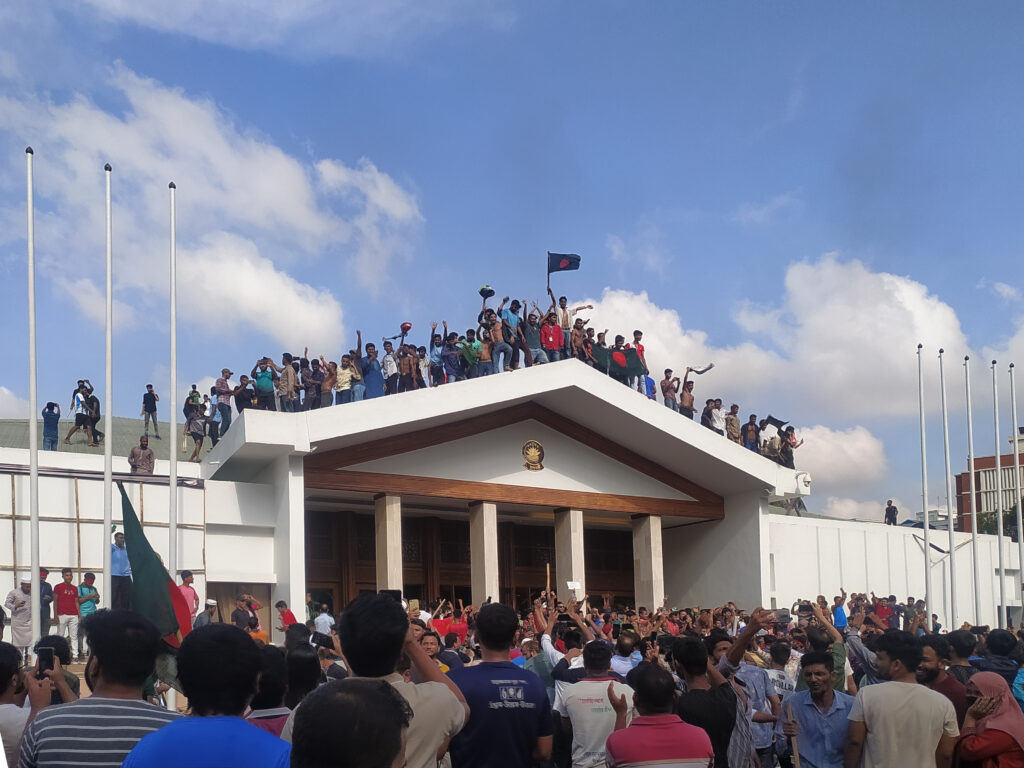
The first major consequence of the Sheikh Hasina death sentenced ruling was the immediate disqualification of the Awami League from participating in future elections. A party that structured Bangladesh’s politics for decades has been dismantled overnight. Senior leaders face detention or surveillance, and grassroots party networks have dissolved across multiple districts.
The Bangladesh Nationalist Party (BNP), long crippled by legal restrictions and administrative pressure, suddenly finds itself with political space it hasn’t had in years. Yet filling the vacuum left behind by the Awami League is proving far more difficult than anticipated. Bangladesh’s political ecosystem has been built around rivalry, suppression, and personality-driven narratives. Removing a central player does not automatically restore balance — it often produces chaos.
The interim government led by Muhammad Yunus is now under scrutiny. Initially praised for stabilising an inflamed nation, it now faces allegations of delaying elections and centralising authority. Sporadic clashes, localised bombings, and power struggles across districts indicate that the verdict has deepened fractures rather than healing them.
Bangladesh is not merely transitioning from one leadership to another. It is undergoing a structural rupture.
Also ready about- Gen Z Protests in Nepal: From Nepo Kids, Corruption, Social Media Ban to Western Interference—What It Means for India
India’s Diplomatic Tightrope: Shelter, Strategy, and Risk
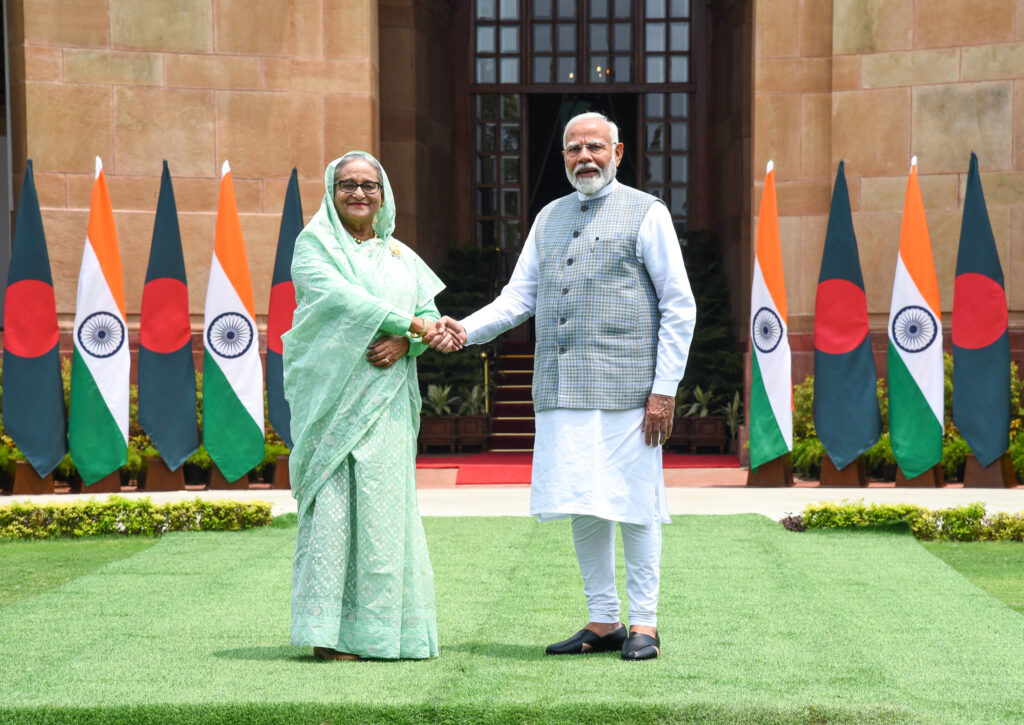
The Sheikh Hasina death sentence has placed India in a diplomatically perilous position. With Hasina currently on Indian soil, New Delhi must choose between treating her as a political refugee, a convicted fugitive, or a former ally whose return could destabilise an already volatile situation.
Bangladesh has officially requested her extradition. The interim leadership has also criticised Indian media for broadcasting her statements and accused New Delhi of interfering indirectly in Bangladesh’s internal affairs. India, meanwhile, must weigh the risks of extraditing a former ally who faces execution — a move that could backfire both regionally and domestically.
Hasina long served as India’s most dependable partner in South Asia. Now, supporting her risks antagonising the current Bangladeshi administration, while abandoning her risks undermining India’s reputation as a stable regional power. New Delhi must balance strategic alliances, border security concerns, and the optics of being entangled in another nation’s judicial turmoil.
Whatever India chooses will shape the next decade of South Asian geopolitics.
Public Sentiment and the Information War
Search trends across both countries show an unprecedented spike in interest surrounding the Sheikh Hasina death sentenced news. The public is divided along sharply polarised lines. Her supporters describe the verdict as political revenge; her critics frame it as long overdue accountability. Neutral observers remain wary of both extremes, recognising that Bangladesh’s political landscape has always suffered from a blurred line between justice and power.
Social media narratives are shaping opinion faster than institutions can stabilise the situation.
The Editorial Viewpoint: Justice Served or Justice Weaponised?
The charges against her are serious, and the state violence of 2024 cannot be ignored. Command-level responsibility is a core principle in modern governance; leaders are accountable not only for their intentions but for the consequences of their orders. If the allegations and evidence hold, the Sheikh Hasina death sentence addresses a fundamental breach of democratic and humanitarian norms.
However, that truth sits beside another uncomfortable reality: the process that delivered this punishment appears deeply entangled with political motivations. The ICT was created for prosecuting 1971 war criminals, not contemporary political actors. Its expansion into modern political disputes signals a distortion of its original mandate. That distortion alone undermines confidence in the tribunal’s neutrality.
Additionally, the timing — punishment only after a leader falls from power — reinforces the pattern seen in many fragile democracies, where justice becomes a tool wielded by the victors rather than a neutral institution. The absence of a robust defense, the sweeping political bans, and the broader restructuring of Bangladesh’s political space raise legitimate concerns about whether this was justice or political engineering.
Both narratives carry truth: Sheikh Hasina may indeed bear responsibility for mass state violence. Yet the system prosecuting her may itself be compromised. These two threads together define the gravity and complexity of this moment.
Historical Context: The Tribunal’s Mission Rewritten
The International Crimes Tribunal was built to prosecute historic injustices tied to the 1971 liberation war. It was never intended to arbitrate contemporary political conflicts. Its gradual transformation into a tool for present-day political accountability reflects a shift that has blurred the line between historical justice and political convenience.
Such a transformation risks weakening the tribunal’s legitimacy and eroding public trust.
The Road Ahead: Uncertainty as the New Normal
Bangladesh now stands in a precarious position. Unrest continues to simmer across several districts, the Awami League’s dismantling has created a leadership void, and the interim administration faces increasing criticism. Whether elections scheduled for 2026 will remain credible depends on whether the political environment stabilises enough to allow genuine participation.
India’s response to the Sheikh Hasina death sentence and the extradition request will shape regional diplomacy, border security dynamics, and bilateral trust. And the broader question of whether the verdict represents accountability or political retribution will continue to shape public debate.
Bangladesh is entering a period defined by uncertainty, contested legitimacy, and institutional fragility.
Conclusion
The Sheikh Hasina death sentenced verdict is far more than a legal ruling. It is a political rupture, a geopolitical shockwave, and a test of institutional integrity. It dismantles a long-standing political order, destabilises a key South Asian nation, complicates India’s diplomatic calculus, and reframes the meaning of justice in Bangladesh.
Whether this moment leads the country toward accountability or pushes it deeper into authoritarian retaliation will depend on the decisions made in Dhaka, in New Delhi, and on the streets where Bangladesh’s future is being reshaped in real time.
People Also Ask (PPA): Bangladesh EX-PM Sheikh Hasina Death Sentenced: Turmoil in Bangladesh and Rewired South Asian Politics
1. What is the Sheikh Hasina death sentenced verdict about?
The verdict accuses Sheikh Hasina of authorising excessive force and human rights abuses during the 2024 student protest crackdown.
2. Why was Sheikh Hasina given the death sentence?
The tribunal ruled that she orchestrated violent state actions, sanctioned military-grade force, and failed to stop atrocities committed by security forces.
3. Was Sheikh Hasina present during the trial?
No. The Sheikh Hasina death sentenced ruling was delivered in absentia while she remained in India.
4. What evidence was used to convict her?
Intercepted communications, audio recordings, military defector testimony, and UN documentation formed the core evidence.
5. Is the verdict considered fair?
Many legal experts argue the trial lacked procedural integrity due to its speed, opacity, and absence of a defense counsel chosen by Hasina.
6. What role did the 2024 student protests play in the case?
The entire case is built on state violence committed during the nationwide 2024 protests, where over 1,400 deaths were reported.
7. What happens if India refuses to extradite her?
Refusing extradition risks diplomatic tension, trade complications, and strategic friction between India and Bangladesh.
8. Can the death sentence be appealed?
Technically yes, but only if Sheikh Hasina returns to Bangladesh or appoints a defense team recognised by the tribunal.
9. How has Bangladesh’s political landscape changed after the verdict?
The Awami League faces bans and disintegration, the BNP gains space, and the country enters a dangerous power vacuum.
10. What are global reactions to the Sheikh Hasina death sentenced ruling?
International observers are divided—some emphasise accountability, others condemn the verdict as politically weaponised.
Frequently Asked Questions (FAQs) Bangladesh EX-PM Sheikh Hasina Death Sentenced: Turmoil in Bangladesh and Rewired South Asian Politics
1. What led to Sheikh Hasina’s downfall before the death sentence?
A nationwide revolt against her government’s crackdown and collapsing political control.
2. Why did Sheikh Hasina flee to India?
She left Bangladesh after losing control of state institutions and facing potential arrest.
3. Is the death sentence against Sheikh Hasina politically motivated?
Critics argue that the timing and process suggest political engineering.
4. What is the International Crimes Tribunal’s mandate?
Originally, it was created to prosecute 1971 war crimes—not modern political crises.
5. Did the tribunal overstep its authority in this verdict?
Many experts say prosecuting contemporary political violence stretches its legal mandate.
6. How are Bangladeshis reacting to the verdict?
The public is sharply divided, with some seeing justice served and others seeing political revenge.
7. Will the 2026 elections be affected by the verdict?
Yes. The political vacuum makes a stable and fair election highly uncertain.
8. What does this verdict mean for India–Bangladesh relations?
It places India in a diplomatic dilemma, balancing moral responsibility with strategic interests.
9. Could the sentence destabilise South Asia?
Yes. It reshapes alliances, increases tensions, and fuels political unpredictability.
10. What are the implications if Hasina remains in India indefinitely?
It could prolong bilateral tensions and keep the political crisis unresolved.

Pratik Kondawale
Strategist | Indian Defence & Global Affairs
Founder of GeoLens.in, Pratik writes in-depth analysis on India’s defence strategy, military tech, and global power shifts delivering sharp insights through an Indian lens.
US House Passes Massive $1.15 Trillion Defense Bill: What It Means for America, China, India, and the World
The United States House of Representatives has approved a historic $1.15 trillion Defense Bill , for Fiscal Year 2027, marking one of the largest military
China’s Warning and Nuclear Tensions in the Russia Ukraine War
The Russia Ukraine War has become one of the most defining conflicts of the 21st century, reshaping global geopolitics, economics, and security. What began as a territorial dispute in February 2022 has evolved into a prolonged war with far‑reaching consequences. Recently, China issued a rare and direct warning to Russia, urging it not to use nuclear weapons in Ukraine. This development highlights the seriousness of the situation and the growing fear of escalation beyond conventional warfare.

What`s Happening in POK, Why POK protestors ask India for help in 2026
In a striking turn of events, Their plea—POK protestors ask India for help—is more than a humanitarian request; a viral video from Pakistan‑occupied Kashmir (POK)
India Declares 23 Individuals as Terrorists: A New Chapter in Counterterrorism
Introduction India Declares 23 Individuals as Terrorists under the Unlawful Activities (Prevention) Act (UAPA), marking a significant escalation in its fight against cross‑border militancy. This

52000 Crore Defence Deal: Defence Acquisition Council Approves
India has taken another major step towards strengthening its armed forces and accelerating defence modernization. The Defence Acquisition Council (DAC), chaired by Defence Minister Rajnath

US Dollar Bypassing? India Japan Local Currency Trade: How Yen-Rupee Settlement Can Reduce Costs and Transform Bilateral Commerce
India and Japan are exploring a groundbreaking: India Japan Local Currency Trade framework that would enable direct settlements in yen and rupees, reducing reliance on