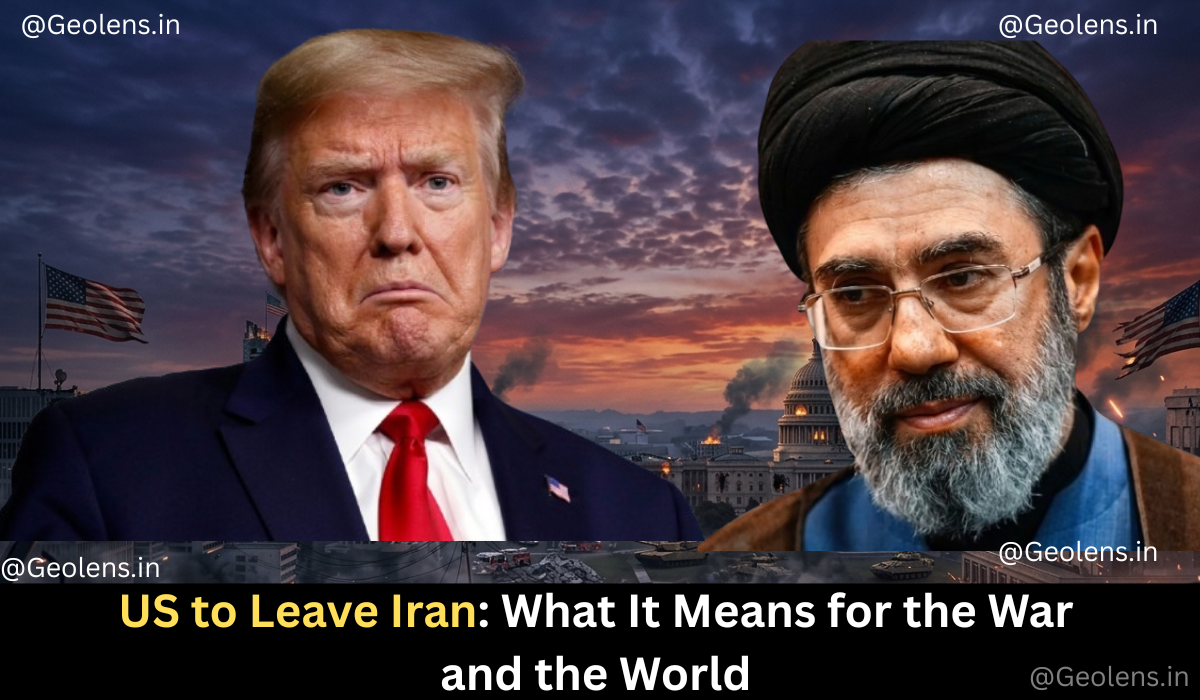
The announcement that the US to leave Iran “very soon” has sent shockwaves across global politics and markets. While Washington signals disengagement, the battlefield tells a different story. Drone strikes, explosions, and regional spillovers show that the conflict is far from over.
This article breaks down the situation in detail, exploring the positions of key players, the economic consequences, and the broader global impact.
US to leave Iran : Trump’s Exit Timeline
President Donald Trump has declared that the US to leave Iran within two to three weeks. His plan is not about signing a peace deal but about weakening Iran’s military and nuclear capabilities enough to prevent future threats.
This approach reflects Washington’s belief that wars can end without treaties — by leaving the opponent too weak to fight back. Yet history warns that such exits often create power vacuums, fueling instability instead of peace. Examples from Iraq and Afghanistan show that sudden withdrawals can lead to the rise of extremist groups or renewed regional conflicts.
President Donald Trump has declared that the US to leave Iran within two to three weeks. His plan is not about signing a peace deal but about weakening Iran’s military and nuclear capabilities enough to prevent future threats.
This approach reflects Washington’s belief that wars can end without treaties — by leaving the opponent too weak to fight back. Yet history warns that such exits often create power vacuums, fueling instability instead of peace. Examples from Iraq and Afghanistan show that sudden withdrawals can lead to the rise of extremist groups or renewed regional conflicts.
US to leave Iran : Rubio’s Optimism
US Secretary of State Marco Rubio echoed Trump’s stance, saying the war’s end is “coming soon.” He believes Iran lacks strong external support and that Washington is firmly in control.
Rubio’s optimism is designed to reassure both domestic and international audiences. However, optimism in Washington contrasts with realities on the ground. Iran’s network of militias and proxies — from Hezbollah in Lebanon to the Houthis in Yemen — remains active and capable of prolonging the conflict even after the US to leave Iran.
This raises a critical question: does leaving Iran truly end the war, or does it simply shift the battlefield to proxy conflicts across the region?
US to leave Iran : Iran’s Position
Iranian President Masoud Pezeshkian has shown signs of compromise. He is willing to end hostilities but wants guarantees that the war will not restart. Earlier demands for reparations have been dropped, showing Iran’s pragmatic shift under pressure.
Still, Iran holds a powerful card: the Strait of Hormuz. Any disruption here could choke global oil supplies, keeping Tehran central to the global conversation even after the US to leave Iran. Iran’s ability to threaten global energy flows ensures it remains relevant, even if weakened militarily.
This balancing act — compromise on reparations but insistence on guarantees — reflects Iran’s strategy of survival. Tehran knows that even if the US to leave Iran, Israel and regional rivals may continue pressure.
US to leave Iran : Israel’s Determination
Prime Minister Benjamin Netanyahu insists Israel will continue fighting until all objectives are met. He highlighted stronger ties with the US and unnamed regional allies, signaling Israel’s readiness for a longer campaign.
This shows a clear difference between US and Israeli priorities. While Washington wants disengagement, Israel sees the war as existential and refuses to stop until Iran’s influence is crushed. For Israel, the US to leave Iran could mean greater responsibility and risk, forcing Tel Aviv to escalate independently.
Israel’s determination also reflects domestic politics. Netanyahu’s government has built its legitimacy on security concerns, and any sign of weakness against Iran could undermine his position.
US to leave Iran : Escalation Across the Gulf
Despite talk of winding down, violence is spreading:
- Tehran: Explosions and air defense activity.
- Kuwait: Drone strikes hit airport fuel tanks.
- Bahrain: Fires at business facilities blamed on Iran.
- Qatar: A tanker struck near Doha.
- Lebanon: Hezbollah attacks Israel, triggering retaliatory strikes in Beirut.
The war is spilling across borders, pulling more countries into the crisis even as the US to leave Iran. This escalation shows that wars rarely end neatly. Instead, they fragment, spreading instability across neighboring states.
US to leave Iran : India’s Stance
India has taken a cautious, balanced approach:
- Neutral diplomacy: Calling for dialogue and de‑escalation.
- Energy concerns: As one of the largest oil importers, India fears disruptions in the Strait of Hormuz.
- Strategic balance: Maintaining ties with both Washington and Tehran to protect its economic lifelines.
India’s position reflects its broader foreign policy of “strategic autonomy” — staying neutral while safeguarding national interests. For New Delhi, the US to leave Iran is both an opportunity and a risk. On one hand, reduced US presence may open space for India to strengthen ties with Tehran. On the other, instability in the Gulf threatens India’s energy security and economic stability.
US to leave Iran : Impact on Global Oil and Inflation
The war is already affecting global markets:
- Oil prices rising: Attacks on Gulf infrastructure raise fears of shortages.
- Inflation pressure: Higher energy costs affect transport, manufacturing, and food prices.
- Developing nations hit hardest: Countries dependent on imports, including India, face rising fuel bills and economic strain.
For ordinary people worldwide, this means costlier goods and tighter household budgets. The US to leave Iran may not immediately ease these pressures. In fact, uncertainty about the withdrawal could push oil prices higher, as markets fear instability in the Gulf.
US to leave Iran : Who Is Benefiting?
While most suffer, some gain from the chaos:
- Defense contractors: US and Israeli arms suppliers profit from demand.
- Energy exporters: Countries like Saudi Arabia and Russia benefit from higher oil prices.
- Regional militias: Groups like Hezbollah and the Houthis expand influence amid instability.
This highlights a harsh truth: wars often enrich a few while hurting millions. The US to leave Iran may shift the balance of beneficiaries, but the pattern remains — instability creates winners and losers, often at the expense of civilians.
Scenario Analysis
- Rapid US Withdrawal: Could leave Israel isolated, forcing it to escalate alone.
- Prolonged Conflict: Proxy wars across Lebanon, Yemen, and the Gulf drag on.
- Negotiated Settlement: Possible only if oil disruptions risk global recession.
Each scenario carries risks, but uncertainty remains the common thread. The US to leave Iran may change the shape of the conflict, but it does not guarantee peace.
Counterarguments & Author’s Viewpoint
Some analysts say the US to leave Iran shows strength — proof that objectives are met. Others argue it reflects fatigue, leaving allies vulnerable. Similarly, while rising oil prices hurt consumers, exporters claim they stabilize markets by encouraging production elsewhere.
These counterarguments highlight the complexity of interpreting the war’s signals. What appears as weakness to one observer may be strategy to another.
The paradox is clear: leaders talk of ending the war, but the battlefield expands daily. India’s cautious diplomacy shows how middle powers navigate crises — balancing energy needs with geopolitics. The real winners are defense industries and opportunistic actors, not civilians.
The key takeaway: timelines may offer hope, but the war’s economic and strategic consequences will last far beyond the battlefield, even after the US to leave Iran. The announcement is not the end of the story; it is the beginning of a new phase of uncertainty.
Conclusion
The US to leave Iran is more than a military decision. It is a global event shaping oil prices, inflation, and diplomacy. Whether it ends in weeks or drags on for months, its impact will be felt worldwide — in homes, markets, and diplomatic corridors.
For policymakers, businesses, and ordinary citizens, the message is clear: prepare for turbulence. The war may change form, but its consequences will remain long after the last American soldier departs.
US House Passes Massive $1.15 Trillion Defense Bill: What It Means for America, China, India, and the World
The United States House of Representatives has approved a historic $1.15 trillion Defense Bill ,…
China’s Warning and Nuclear Tensions in the Russia Ukraine War

What`s Happening in POK, Why POK protestors ask India for help in 2026
In a striking turn of events, Their plea—POK protestors ask India for help—is more than…
India Declares 23 Individuals as Terrorists: A New Chapter in Counterterrorism
Introduction India Declares 23 Individuals as Terrorists under the Unlawful Activities (Prevention) Act (UAPA),…
52000 Crore Defence Deal: Defence Acquisition Council Approves
India has taken another major step towards strengthening its armed forces and accelerating defence…

US Dollar Bypassing? India Japan Local Currency Trade: How Yen-Rupee Settlement Can Reduce Costs and Transform Bilateral Commerce
India and Japan are exploring a groundbreaking: India Japan Local Currency Trade framework that…