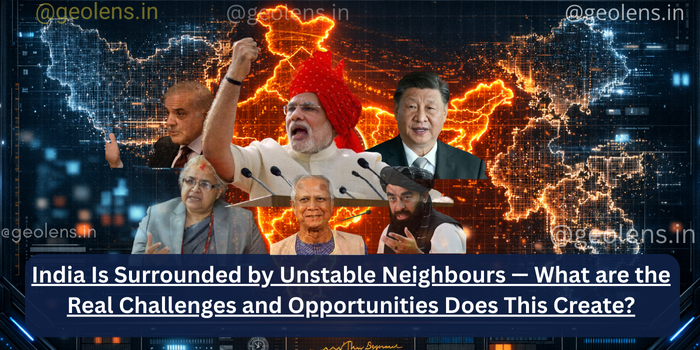
Table of Contents
Synopsis
India surrounded by unstable neighbours faces a uniquely challenging strategic environment. Every bordering country — Pakistan, Afghanistan, China, Bangladesh, Nepal, Myanmar, Sri Lanka, and the Maldives — is dealing with political instability, economic stress, insurgency, or foreign interference. This volatility directly impacts India’s security, borders, and long-term strategic planning.
The biggest pressures come from multi-front military risks, terrorism spillover, illegal migration, refugee inflows, and China’s growing influence across the region. These factors force India to maintain high military readiness, expand intelligence operations, and continuously invest in border and maritime security.
However, instability also creates opportunities. India can consolidate its role as the region’s stabilizer by offering economic support, crisis management, defence cooperation, humanitarian assistance, and infrastructure alternatives to China. This strengthens India’s diplomatic weight, defence exports, maritime presence, and overall regional influence.
In short, being India surrounded by unstable neighbours is both a burden and an advantage. It compels India to grow as a hard-power military state and simultaneously as the region’s primary stabilizing force — shaping its future security, diplomacy, and leadership.Top of Form
Introduction: India’s Neighbourhood Is Not Normal — And That Shapes Everything
If you take a straight look at the map — and more importantly, at the political health of the states around India — the pattern is obvious. India is a rising power located in a region that has never been geopolitically stable. Almost every neighbouring country faces some mix of:
- Political volatility
- Military coups or weak civilian leadership
- Ethnic or separatist conflicts
- Islamist militancy or insurgency
- Economic collapse or IMF dependency
- Heavy foreign influence (China above all)
- Fragile institutions
- Refugee-producing crises
This isn’t a coincidence. South Asia is one of the least integrated, least economically coordinated, and most politically fragmented regions in the world.
For India, this is both a curse and a strategic reality that shapes every national-security decision, every defence budget priority, every diplomatic stance, every alliance, and every trade initiative.
This article breaks down real challenges, real opportunities, and what all of this forces India to become in the long run.
PART 1: INDIA’S NEIGHBOURS — A RAPID REALITY CHECK
Before analyzing the bigger picture, it’s necessary to understand the instability profile of each neighbour. This isn’t opinion — these are structural patterns.
1. Pakistan: Instability by Design — and How It Shapes India’s Security Environment
When we say India Is Surrounded by Unstable Neighbours, Pakistan is the most critical example. Its instability is not accidental — it is deliberately maintained by its military establishment because chaos keeps the Army in control and relevant.
Below is the revised section in sentence + points format, integrating Asim Munir, U.S. involvement, Trump’s remarks, Imran Khan’s disappearance, Operation Sindoor, and India’s water leverage.
Pakistan: Engineered Unpredictability Under a Military Corporation
Pakistan remains India’s most volatile neighbour because the country is fundamentally structured to stay unstable. The Army and ISI treat instability as a resource — something they can weaponize against political challengers domestically and against India externally. This is one of the biggest reasons why India Is Surrounded by Unstable Neighbours becomes a continuous strategic challenge.
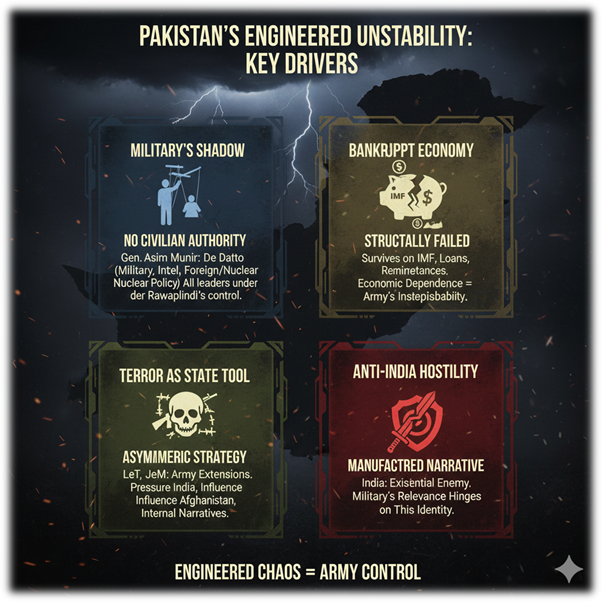
Key drivers of Pakistan’s instability:
- Civilian governments have no real authority.
Every elected leader operates under the shadow of Rawalpindi. Today, General Asim Munir functions as the de facto ruler, controlling Pakistan’s military, intelligence apparatus, foreign policy, and nuclear decisions. - The economy is structurally bankrupt.
Pakistan survives on IMF bailouts, foreign loans, and remittances. The system is designed to fail because economic dependence keeps the Army indispensable. - Terror groups remain state tools.
LeT, JeM, and other outfits function as extensions of the Army’s asymmetric strategy. They are used to pressure India, influence Afghanistan, and maintain internal narratives. - Anti-India hostility is deliberately manufactured.
The Pakistani state’s identity hinges on portraying India as an existential enemy. Without this narrative, the military loses relevance.
The Asim Munir Factor: A Military Dictatorship in All but Name
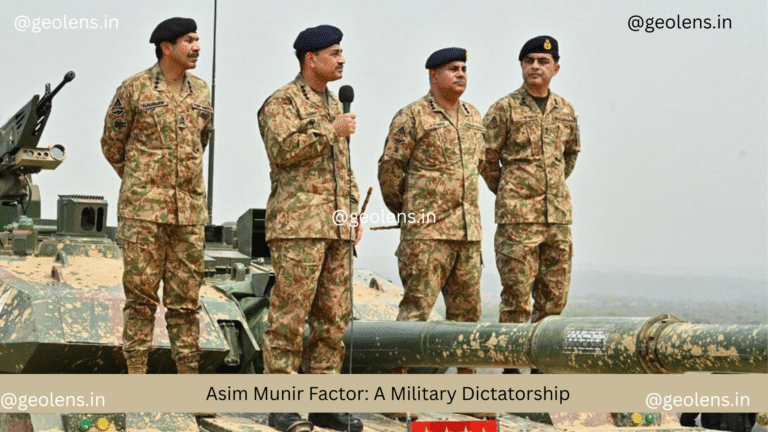
General Asim Munir is effectively running the country, and several geopolitical signals confirm this.
Key points:
- Munir holds absolute control over Pakistan’s internal and external decisions.
- The U.S. maintains close ties with Pakistan’s Army to secure access to Afghanistan and nuclear oversight.
- Donald Trump publicly referred to Munir as “my favorite field marshal,” showing the depth of U.S.–Pakistan military rapport.
- This external backing helps Munir sustain a controlled level of instability — not enough for collapse, but enough to pressure India.
Delhi Blast 2025: Terror Networks, Pakistan’s Military State, and India’s Strategic Dilemma
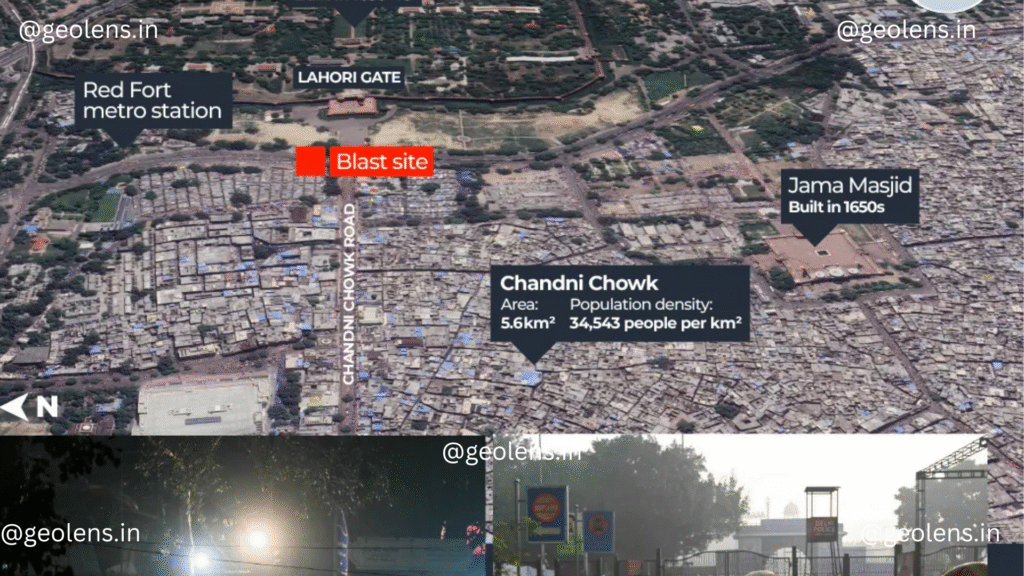
For a country where India Is Surrounded by Unstable Neighbours, the November 2025 Delhi car explosion near the Lal Qila metro station became more than a terror incident—it exposed how domestic radicalization, cross-border networks, and Pakistan’s military-centric power structure intersect.
Preliminary investigations indicated that the attack was not an isolated act but part of a wider, well-organized terror module operating between Kashmir and mainland India. The identification of Umar Mohammed, a medical professional with links across Pulwama and Faridabad, pointed to a disturbing pattern: educated operatives embedded in civilian ecosystems, allegedly guided by external handlers.
Earlier recoveries of explosives and weapons in Faridabad reinforced the assessment that this was a logistics-heavy operation, not a lone-wolf attack.
The case quickly drew attention to militant groups such as Jaish-e-Mohammed and Ansar Ghazwat-ul-Hind, organizations with a long history of operating from Pakistani soil. While New Delhi stopped short of a formal accusation, public remarks by leaders in Pakistan-administered Kashmir — followed by Islamabad’s silence — kept the Pakistan angle firmly in play.
This incident unfolded against the backdrop of Pakistan’s internal authoritarian consolidation under Army Chief Asim Munir, the country’s de facto ruler. With civilian leadership sidelined, political opposition crushed, and figures like Imran Khan removed from public visibility amid alarming rumors, Pakistan’s military establishment retains full control over security policy — including its use of militant proxies.
Continued U.S. military engagement with Rawalpindi, and public praise of Munir by American political figures, further complicates India’s deterrence calculus.
India’s response reflected a shift from reactive diplomacy to cost-imposition strategy. Alongside intensified counter-terror operations such as Operation Sindoor, New Delhi tightened its interpretation of Indus water management, signaling that sustained proxy violence would carry consequences beyond the battlefield.
In strategic terms, the Delhi blast highlighted a hard truth: when a neighboring state derives power from instability, terrorism becomes not an aberration but a tool.
For India, this reinforces why being surrounded by unstable neighbours is not just a geographic challenge, but a permanent condition shaping its security doctrine, intelligence priorities, and regional posture.
The Imran Khan Mystery: Disappearance, Rumors, and State Brutality

The treatment of former PM Imran Khan reveals how deep Pakistan’s authoritarian slide has become under Munir’s rule.
Key developments:
- Imran Khan remains hidden from public view, sparking viral death rumors.
- The state has provided zero transparent proof of his physical or medical condition.
- His sisters were brutally beaten outside Adiala Jail, raising global suspicion that something is seriously wrong internally.
- The crackdown demonstrates how the Army eliminates political threats, not competes with them.
This chaos creates a security spillover that India cannot ignore — another example of how India Is Surrounded by Unstable Neighbours with unpredictable power centres.
Operation Sindoor and India's Strategic Response
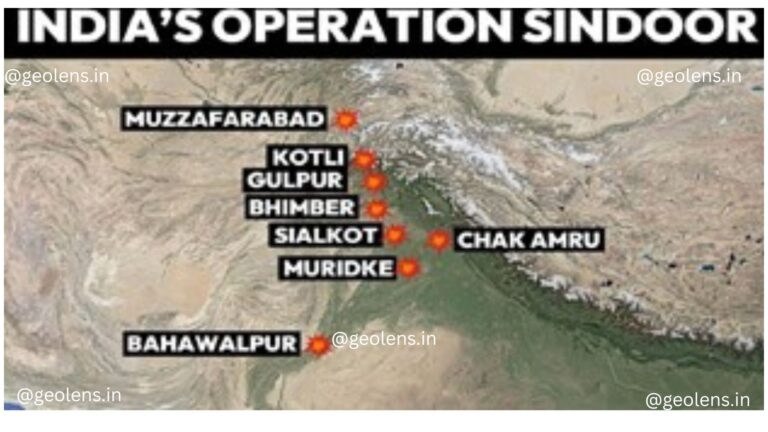
To counter Pakistan’s terror infrastructure, India executed Operation Sindoor, neutralizing key anti-India networks with precision and signalling that New Delhi will impose clear costs for cross-border aggression.
Also ready about-Operation Sindoor: How India’s S-400 Shot Down 5 Pakistani Jets and 1 AEW&C/ELINT Aircraft: IAF chief calls S-400 a ‘Game-Changer’.
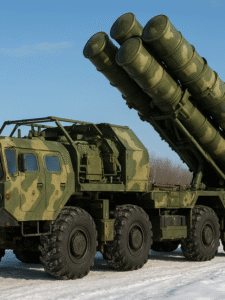
India’s strategic actions on India Is Surrounded by Unstable Neighbours
- Targeted dismantling of Pakistan-based terror pipelines.
- Intelligence-driven operations along the LoC and internal containment.
- Water leverage: India adjusted Indus water flows, optimized upstream storage, and tightened treaty interpretation — sending a message that terror attacks will have consequences beyond diplomatic statements.
Impact on India: The Security Burden of a Manufactured Crisis State
Pakistan’s instability directly shapes India’s strategic environment. For New Delhi, the problem isn’t just a “difficult neighbour” — it’s a nuclear-armed military corporation next door that thrives on chaos.
Core challenges for India:
- Border volatility: Ceasefire violations and infiltration rise whenever Pakistan faces internal pressure.
- Terrorism risk: Militants remain operational with state support.
- Nuclear blackmail: Pakistan uses nuclear threats casually to block diplomatic pressure.
- Diplomatic uncertainty: India must deal with an Army that answers to no civilian authority.
All of this reinforces why India Is Surrounded by Unstable Neighbours is not merely a geographic statement — it is a structural strategic reality.
2. Afghanistan: A Collapsed State, a Terror Vacuum, and Strategic Pressure on India
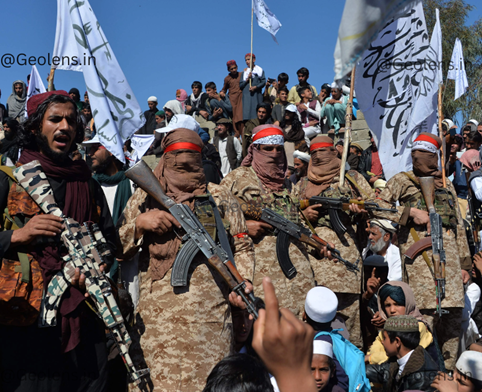
When assessing why India Is Surrounded by Unstable Neighbours, Afghanistan represents the most extreme case: a country that has shifted from chronic instability to near-total state collapse under the Taliban.
Since the Taliban’s return to power, Afghanistan has ceased to function as a conventional state and instead operates as a fragmented territory dominated by militant factions, ideological hardliners, and transnational terror networks.
For India, the challenge is not actually direct border confrontation but strategic spillover.
Core challenges for India
Afghanistan today creates three interlinked risks for India:
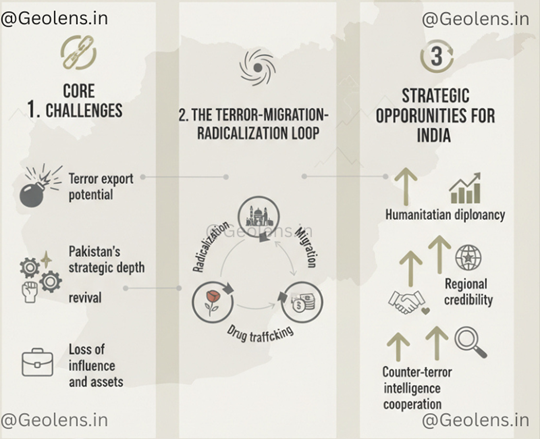
- Terror export potential: Groups such as ISIS-K, Al-Qaeda-linked elements, and Pakistan-backed militants operate in overlapping spaces. Even if the Taliban publicly claim restraint, they lack full territorial or ideological control.
- Pakistan’s strategic depth revival: With Kabul aligned to Rawalpindi’s interests, Pakistan has regained leverage it lost during the pre-2021 period. Afghan soil once again risks being used indirectly against India.
- Loss of influence and assets: India’s development projects, diplomatic presence, and long-term investments built over two decades were effectively erased overnight, reducing New Delhi’s visibility and leverage in Central Asia.
Unlike Pakistan, Afghanistan’s instability is not weaponized through state institutions — it is weaponized through absence of institutions. This makes attribution difficult, intelligence murky, and deterrence weak.
The Terror–Migration–Radicalization Loop
Afghanistan’s collapse has also revived a familiar pattern:
- Radicalization pipelines feeding into South Asia
- Uncontrolled migration flows across the region
- Drug trafficking routes financing extremist groups
While India does not share a direct border with Afghanistan, these networks travel through Pakistan, Iran, and maritime routes, creating indirect but persistent security pressure.
This is a textbook example of how India Is Surrounded by Unstable Neighbours does not require physical proximity to create threat vectors
Opportunities for India: Limited but Strategic
Despite the bleak landscape, Afghanistan still presents narrow but real opportunities for India:
- Humanitarian diplomacy: India’s continued supply of food aid and medicines keeps channels open without legitimizing the regime.
- Regional credibility: India’s restraint and consistency contrast sharply with Pakistan’s opportunistic approach, strengthening India’s image as a responsible regional actor.
- Counter-terror intelligence cooperation: Quiet coordination with regional and global partners allows India to monitor evolving threats without direct engagement.
India’s approach reflects strategic realism: engage the people, not the regime; monitor the threat, not the rhetoric.
Strategic Takeaway
Afghanistan reinforces a critical lesson for Indian planners: instability does not need hostility to become dangerous. A failed state can be as threatening as an aggressive one.
For India, Afghanistan’s collapse strengthens the case for:
- Deeper intelligence networks,
- Tighter counter-terror coordination, and
- A regional strategy that assumes persistent instability as the norm, not the exception.
In that sense, Afghanistan is not an outlier — it is a warning. And it underscores why India Is Surrounded by Unstable Neighbours is not a temporary phase, but a defining condition of India’s strategic environment.
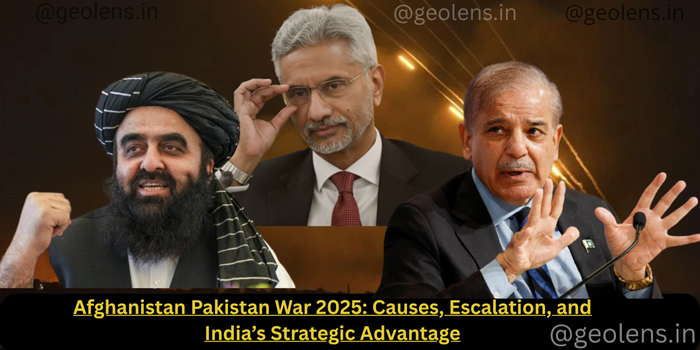
3. China: Systematic Pressure, Strategic Encirclement, and India’s Long Game
If Pakistan represents instability by design and Afghanistan instability by collapse, China represents instability by strategy.
When examining why India Is Surrounded by Unstable Neighbours, China is the central external force amplifying volatility across South Asia through infrastructure leverage, military pressure, and economic dependency traps.
China’s approach toward India is not reactive. It is incremental, patient, and multi-domain, combining military posture, economic coercion, diplomatic signaling, and regional influence-building.

Border Pressure and Military Infrastructure
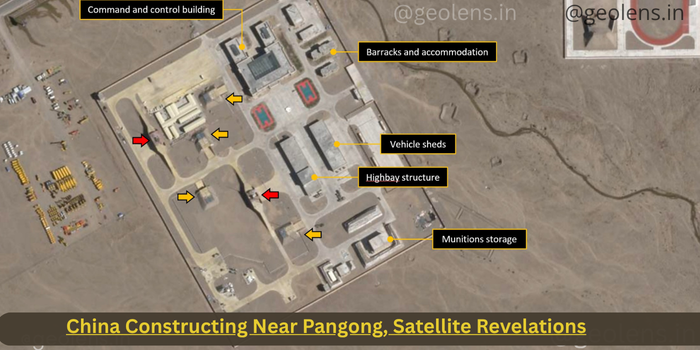
China has dramatically altered the status quo along India’s northern frontier.
Key developments:
- Rapid military infrastructure buildup along the Line of Actual Control (LAC), including all-weather roads, airstrips, logistics hubs, and forward-deployed units.
- Permanent military presence in Aksai Chin, strengthening China’s hold over territory it occupies illegally, while rejecting any rollback.
- Regular transgressions and patrol intrusions in eastern Ladakh and Arunachal Pradesh, designed to normalize friction and test Indian responses.
- Dual-use infrastructure — civilian facilities that can be converted for military use at short notice.
This is not accidental escalation. It is calibrated pressure intended to keep India strategically boxed while avoiding open war.
Water as Strategic Leverage: Brahmaputra and Beyond
China’s dam construction on the upper reaches of the Brahmaputra (Yarlung Tsangpo) introduces a new dimension of concern.
Strategic risks:
- Large-scale hydropower and water control projects give Beijing long-term leverage over downstream flows into India and Bangladesh.
- While China publicly denies hostile intent, lack of data transparency and absence of binding water-sharing agreements create strategic uncertainty.
- In a crisis scenario, water manipulation — even temporarily — could disrupt agriculture, ecology, and livelihoods in India’s northeast.
Water may not be weaponized today, but infrastructure creates optionality — and strategic planners always think in options.

Debt Traps, BRI, and Regional Destabilization
China’s Belt and Road Initiative (BRI) has reshaped India’s neighbourhood — not through growth, but through dependency.
Key patterns across South Asia:
- Sri Lanka: Debt-driven loss of strategic assets such as Hambantota Port.
- Pakistan: CPEC deepening financial dependence while militarizing infrastructure.
- Nepal, Maldives, Myanmar: Rising debt exposure, political influence, and strategic concessions.
These projects often bypass local accountability, undermine sovereignty, and create political instability, which in turn weakens regional resistance to Chinese pressure.
This reinforces why India Is Surrounded by Unstable Neighbours is inseparable from China’s economic statecraft.
Pakistan as China’s Forward Proxy
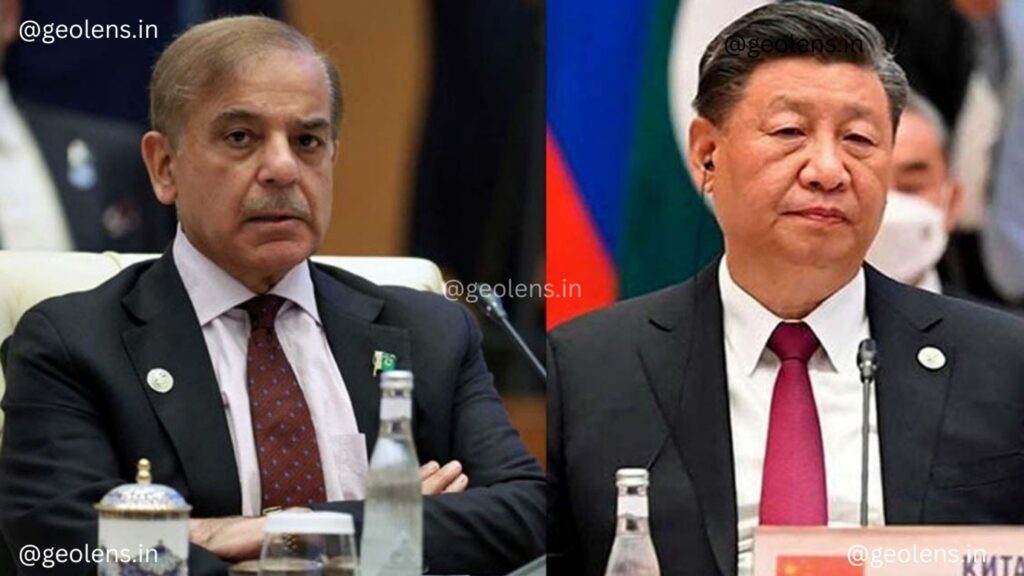
China’s backing of Pakistan is not ideological — it is strategic.
Support includes:
- Advanced military hardware, joint production, and technology transfer.
- Diplomatic shielding at international forums.
- Financial assistance that sustains Pakistan despite chronic economic failure.
Pakistan absorbs pressure that China prefers not to face directly, keeping India distracted on its western front while Beijing consolidates elsewhere.
Information, Influence, and Grey-Zone Pressure
China rarely confronts India directly. Instead, it applies grey-zone tactics:
- Political influence operations in neighbouring states.
- Strategic investments that reshape elite incentives.
- Diplomatic pressure to limit India’s regional leadership.
- Indirect encouragement of instability through economic leverage rather than overt violence.
Unlike Pakistan, China does not need terrorism. Economic dependency is its weapon of choice.
The Siliguri Corridor:
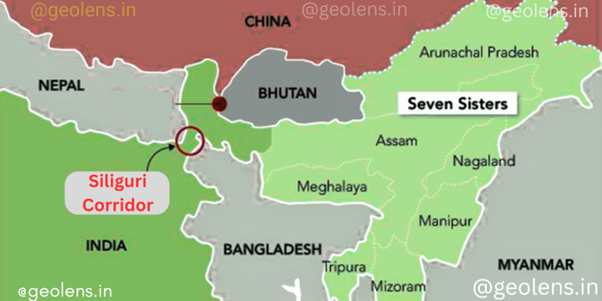
Siliguri is critical to India because it is the only land link connecting mainland India to the entire Northeast—eight states, over 45 million people, major military formations, borders with China, Bhutan, Bangladesh, and Myanmar.
At its narrowest point, the corridor is just 20–25 km wide. If this strip is cut or disrupted, the Northeast is effectively isolated from the rest of India, crippling logistics, troop movement, trade, and governance. That extreme narrowness is why it’s bluntly called India’s “Chicken’s Neck”—squeeze it, and the body (Northeast India) is cut off.
China wants to break or neutralize this Chicken’s Neck not out of symbolism, but cold strategy. The Siliguri Corridor is India’s single biggest land vulnerability.
In a conflict, pressure on this corridor would force India to divert massive military resources just to keep the Northeast connected, weakening India’s posture elsewhere—especially along the LAC and in the Indian Ocean. China’s moves in Doklam, its deep military ties with Bangladesh, infrastructure buildup in Tibet, and support to Pakistan’s eastern pressure strategy all indirectly point to one goal: create multi-directional pressure around Siliguri without firing the first shot.
If China can threaten the corridor, India’s ability to reinforce Arunachal Pradesh or counter Chinese aggression collapses. That’s why India treats Siliguri as non-negotiable red-line territory—and why Doklam in 2017 was stopped at all costs. This isn’t paranoia; it’s basic military math.
China: String of Pearls strategy
China’s String of Pearls strategy (often misheard or misstated as “string of pulses”) is a long-term geopolitical and military plan aimed at protecting China’s critical sea trade routes, especially its energy supply lines.
Because China depends heavily on oil and trade that pass through narrow chokepoints like the Malacca Strait, it fears being economically “choked” during a conflict. To reduce this risk, China has built and financed a chain of ports, infrastructure projects, and political influence points across the Indian Ocean—from Myanmar and Pakistan to Sri Lanka and Africa.
While China labels these projects as commercial and development-oriented, in reality many have dual-use potential, allowing future naval access, logistics support, and intelligence presence. Strategically, this network helps China extend its reach far from its mainland, monitor regional navies, and challenge India’s traditional dominance in the Indian Ocean, making the strategy less about trade and more about power projection and strategic insurance.
India: Necklace of Diamond strategy
Despite India Is Surrounded by Unstable Neighbours India`s Necklace of Diamond Strategy is a maritime security and geopolitical counter to China’s expansion in the Indian Ocean, focused on partnerships rather than territorial control. Instead of building or owning foreign ports, India strengthens strategic access, military cooperation, and intelligence sharing at key locations across the Indo-Pacific.
Each “diamond” represents a trusted partner or access point—such as the Andaman and Nicobar Islands, Duqm (Oman), Chabahar (Iran), Sabang (Indonesia), Reunion Island (France), and cooperation through the QUAD.
The core logic is simple: India leverages geography, naval capability, and alliances to monitor and, if required, control critical sea lanes like the Malacca Strait. Unlike China’s debt-driven infrastructure model, India’s approach is sustainable, legitimate, and defensive, aiming to preserve stability while ensuring India remains the dominant security provider in the Indian Ocean Region.
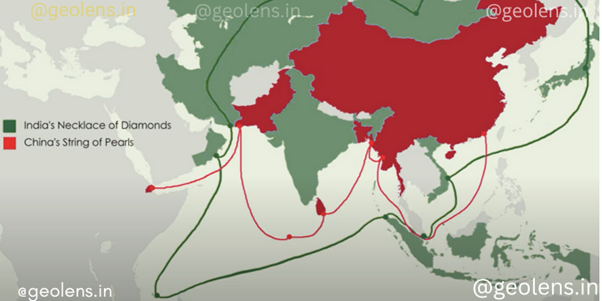
- China’s Problem
China’s economic and military growth depends heavily on maritime trade routes, especially for energy imports. Nearly 80% of China’s oil passes through the Malacca Strait, a narrow chokepoint that can be blocked during conflict. Chinese strategists openly refer to this vulnerability as the “Malacca Dilemma”. China’s economy and war-fighting capability suffer immediately.
- String of Pearls: China’s Response
To reduce this vulnerability, China developed the String of Pearls strategy. It involves building ports, logistics hubs, and infrastructure across the Indian Ocean region.
Key nodes include:
- Gwadar (Pakistan)
- Hambantota (Sri Lanka)
- Kyaukpyu (Myanmar)
- Djibouti (Horn of Africa)
Although officially commercial, these facilities provide dual-use capability—civilian in peacetime, military in crisis. Strategically, this allows China to extend naval presence and apply pressure in India’s maritime neighborhood.
- Strategic Limitation of China’s Approach
China’s model relies heavily on debt leverage and political dependency, which has triggered resistance in several host nations. Moreover, these ports are far from China’s mainland, difficult to defend, and vulnerable in wartime. Expansion does not eliminate China’s core problem—it only stretches Chinese forces thinner across hostile waters.
- India’s “Necklace of Diamonds” Strategy
India’s counter-strategy, known as the Necklace of Diamonds, is fundamentally different. Instead of building controlled ports, India focuses on strategic partnerships, access agreements, and maritime dominance.
Each “diamond” represents trusted cooperation rather than ownership.
- Key Indian Strategic Advantages
India has strengthened its position through:
- Andaman & Nicobar Islands – Overlooking the Malacca Strait, giving India natural leverage over China’s primary chokepoint
- Duqm Port (Oman) – Western Indian Ocean access
- Chabahar Port (Iran) – Strategic gateway bypassing Pakistan
- Sabang Port (Indonesia) – Near Malacca Strait
- France (Reunion Island) – Indian Ocean reach
- QUAD (India-US-Japan-Australia) – Naval interoperability and intelligence sharing
- Why India’s Model Is Stronger
India’s strategy is sustainable, legal, and geopolitically acceptable. It does not trap countries in debt or provoke backlash. Instead, it builds shared security architecture, where multiple nations have a stake in regional stability.
- Strategic Bottom Line
China is trying to protect a vulnerable supply line far from home.
India is shaping the maritime environment where geography already favors it.
In the Indian Ocean Region, China is reacting to insecurity, while India is consolidating dominance. That asymmetry gives India the long-term strategic edge.
India’s Response: Containment Without Confrontation
Despite sustained pressure, India has avoided two traps: escalation panic and strategic paralysis.
India’s balancing approach includes:
- Military preparedness without provocation: Forward deployments, infrastructure parity, and rapid mobilization capability along the LAC.
- Economic decoupling where necessary: Tightened scrutiny of Chinese investments and technology dependence.
- Diplomatic diversification: Strengthening ties with the US, Japan, ASEAN, Europe, and the Quad without formal alliances.
- Regional counter-offers: Infrastructure, digital systems (UPI, RuPay), energy cooperation, and capacity-building in neighbouring states.
- Maritime focus: Expanding naval presence to counterbalance China’s land advantage.
India is not trying to outmatch China overnight — it is buying time while building capacity.
India Is Surrounded by Unstable Neighbours: Opportunities Created by Chinese Pressure
Ironically, China’s assertiveness has accelerated India’s rise in several areas.
Key opportunities:
- Manufacturing diversification: Global supply chains are moving toward India as a China alternative.
- Defence modernization: Indigenous defence production and exports are expanding faster due to perceived threat.
- Strategic relevance: India is now viewed as indispensable to Indo-Pacific stability.
- Internal cohesion: Border pressure has forced faster infrastructure development in India’s frontier regions.
China’s pressure has unintentionally sharpened India’s strategic focus.
Strategic Takeaway: Neck-to-Neck, Not Head-On
Despite India Is Surrounded by Unstable Neighbours , China militarily to succeed.
Its strategy is different:
- Compete economically over decades.
- Match military capability selectively, not symmetrically.
- Outlast China demographically, institutionally, and diplomatically.
- Offer neighbours stability instead of dependency.
China seeks dominance.
India seeks balance.
And in a region where India Is Surrounded by Unstable Neighbours, that balance — sustained patiently — may prove to be India’s strongest advantage.
4. Nepal: Youth-Driven Political Upheaval, Strategic Fragility, and India’s Northern Gateway
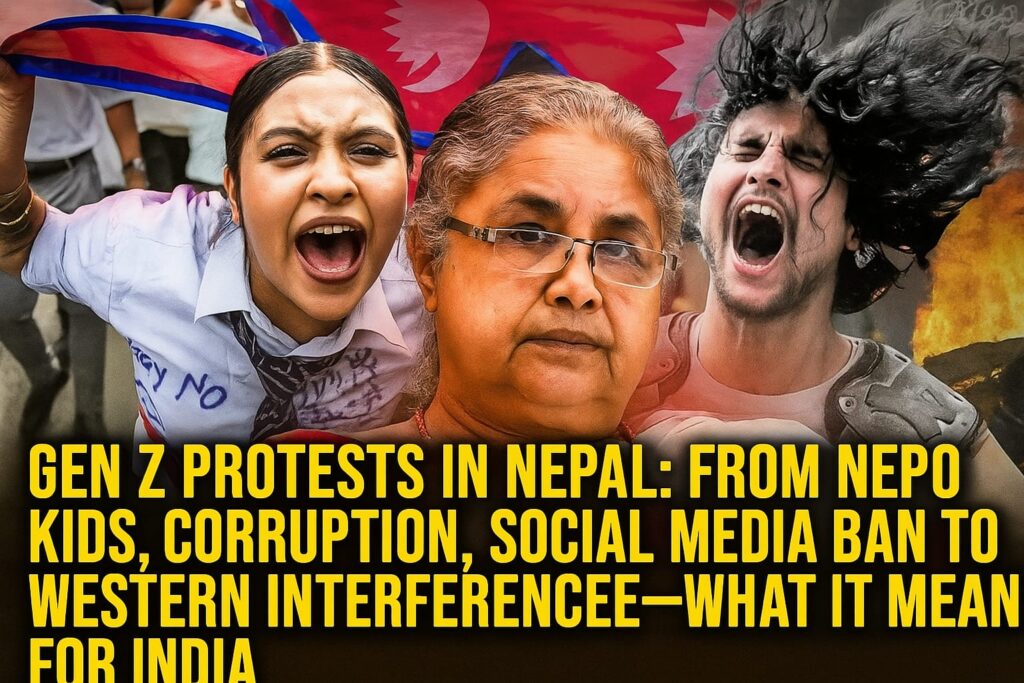
Among all of India’s neighbours, Nepal occupies a uniquely sensitive position. It is not hostile, not collapsed, and not militarized — yet its political instability makes it strategically vulnerable. Recent Gen-Z-led protests have reshaped Nepal’s political landscape, triggering the collapse of the sitting government and reopening space for external influence. This reinforces why India Is Surrounded by Unstable Neighbours even when relations appear friendly on the surface.
India Is Surrounded by Unstable Neighbours: The Gen-Z Protest Effect: A System Shock
Nepal’s recent wave of youth-led protests was not ideological in the traditional sense. It was anti-establishment, anti-corruption, and anti-elite.
Key outcomes of the protests:
- Widespread dissatisfaction with political dynasties and coalition politics.
- Loss of legitimacy for traditional parties.
- Collapse of the sitting government amid public pressure.
- Political vacuum that weakened institutional continuity.
While this reflected genuine domestic frustration, it also destabilized governance at a critical moment, making Nepal more susceptible to external narratives and inducements.
Why Nepal Matters So Much to India
Despite Nepal is not just a neighbour — it is a strategic extension for India is Surrounded by Unstable Neighbours
Core strategic importance:
- Open border: Over 1,700 km with free movement of people, goods, and labor — a rare arrangement globally.
- Himalayan buffer: Nepal sits between India’s heartland and the Tibetan plateau.
- Water security: Nepal controls critical Himalayan river systems feeding northern India.
- Cultural and economic integration: Deep people-to-people ties, workforce interdependence, and shared civilizational space.
Any instability in Nepal immediately spills into India, economically, socially, and strategically.
China’s Interest and the Importance of a Pro-Stability Government
China views Nepal as a pressure point rather than a partner.
Beijing’s objectives:
- Reduce India’s traditional influence.
- Use infrastructure and political outreach to reshape elite incentives.
- Leverage Nepal to monitor or restrict Tibetan refugee activity.
- Create strategic ambiguity along India’s northern frontier.
For India, a stable and India-aware government in Kathmandu is not about control — it is about preventing strategic drift.
A politically unstable Nepal increases China’s room to maneuver, even without overt hostility.
India Is Surrounded by Unstable Neighbours: Challenges for India
Nepal’s instability presents India with several structural challenges:
- Policy unpredictability: Frequent government changes disrupt long-term projects.
- Narrative volatility: Anti-India rhetoric resurfaces during political churn, often amplified externally.
- Border management risks: Open borders can be exploited for smuggling, illegal movement, and intelligence activity.
- Infrastructure competition: Chinese projects may advance faster due to fewer transparency requirements.
This is a classic case where instability, not hostility, becomes the real threat.
India Is Surrounded by Unstable Neighbours: Opportunities for India
Despite the challenges, Nepal’s situation also opens strategic opportunities for India.
Key opportunities:
- Youth engagement: India can connect directly with Nepal’s young population through education, technology, startups, and employment pathways.
- Economic integration: Power trade, cross-border connectivity, and digital infrastructure can deepen interdependence.
- Stability partnership: India can position itself as Nepal’s most reliable long-term partner — not the fastest lender, but the safest one.
- Soft power advantage: Cultural affinity and human networks still overwhelmingly favor India.
Unlike China, India does not need to manufacture influence — it already has it, if used intelligently.
Strategic Takeaway
Nepal demonstrates a crucial reality: instability does not have to be violent to be dangerous. Political churn alone can shift strategic alignments.
India Is Surrounded by Unstable Neighbours, Nepal’s stability is not optional — it is a core national interest. Maintaining a balanced, respectful, and forward-looking relationship with Kathmandu is essential to counter external pressure and preserve the Himalayan buffer.
In the broader context of India Is Surrounded by Unstable Neighbours, Nepal is the neighbour where getting it right matters the most, because the costs of getting it wrong are immediate, silent, and difficult to reverse.
5. Myanmar: Military Rule, Civil War, China’s Corridor, and Direct Spillover Into India’s Northeast
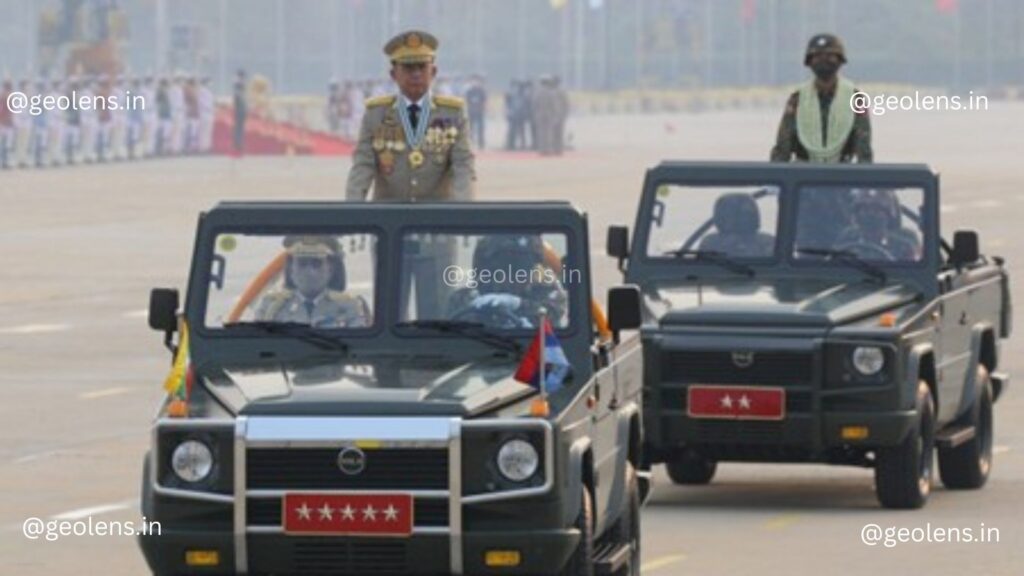
If Pakistan represents engineered instability and Afghanistan collapsed instability, Myanmar represents uncontrolled instability spilling directly into Indian territory. In the broader context of India Is Surrounded by Unstable Neighbours, Myanmar is the only neighbour where civil war, insurgency, foreign influence, and Indian internal security intersect physically.
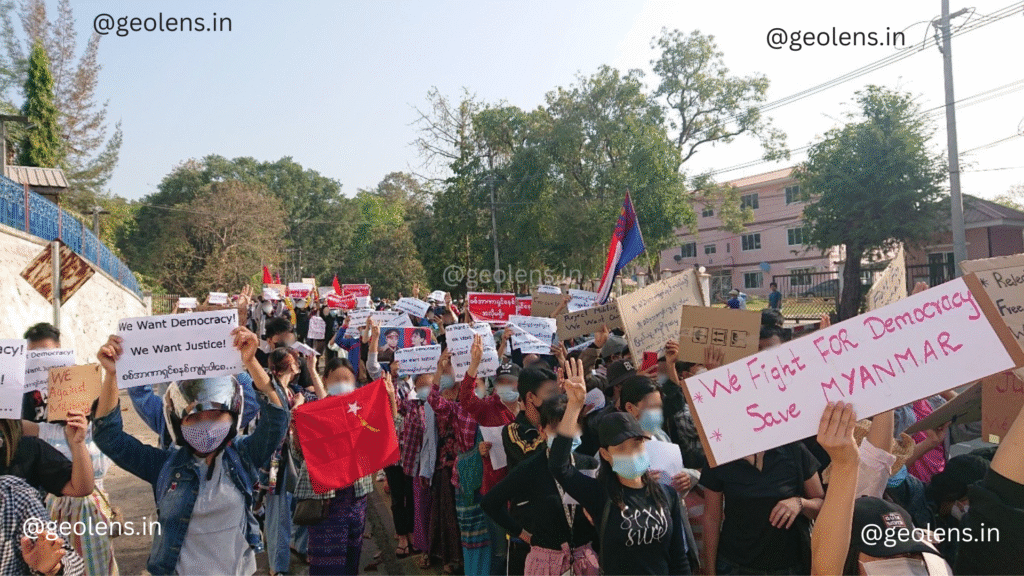
Since the 2021 coup, Myanmar has ceased to function as a unified state and instead exists as a fragmented battlespace.
The Min Aung Hlaing Regime: Power Through Force, Not Governance
Although India Is Surrounded by Unstable Neighbours, Myanmar today is effectively ruled by Senior General Min Aung Hlaing, who controls the state through the military junta (Tatmadaw).
Key realities:
- Aung San Suu Kyi remains imprisoned, removed entirely from political life to eliminate civilian legitimacy.
- Elections are postponed or manipulated to retain military dominance.
- Governance is enforced through coercion, not consent.
- Large parts of the country are outside central control, dominated by ethnic armed organizations and resistance groups.
This has transformed Myanmar into a permanent internal conflict zone, not a temporary crisis.
Civil War and Insurgency: A Regional Security Threat
Myanmar is currently facing:
- Armed resistance by pro-democracy forces.
- Long-running ethnic insurgencies in border regions.
- Criminal networks thriving in lawless zones.
For India, this instability is not distant — it directly touches the Northeast.
Spillover effects into India:
- Insurgent groups from India’s Northeast find safe havens and transit routes in Myanmar’s ungoverned spaces.
- Arms trafficking and drug routes flow across the porous border.
- Refugee inflows into Mizoram and Manipur strain local administration and social cohesion.
- Lawlessness creates opportunities for hostile actors to exploit border regions.
This is one of the clearest examples of how India Is Surrounded by Unstable Neighbours translates into internal security challenges.
China’s Strategic Corridor Through Myanmar
China views Myanmar not as a partner but as a strategic corridor.
China’s objectives include:
- Securing land access to the Indian Ocean through pipelines, roads, and ports.
- Reducing reliance on the Malacca Strait.
- Embedding influence with both the junta and select armed groups.
- Using instability to deepen dependency rather than resolve conflict.
China does not need Myanmar to be stable — it needs it to be manageable.
This complicates India’s position, as instability combined with Chinese leverage creates a long-term strategic vulnerability on India’s eastern flank.
Challenges for India Is Surrounded by Unstable Neighbours
Myanmar’s collapse presents India with multiple, overlapping challenges:
- Internal security risk: Increased insurgent activity and cross-border movement.
- Border management strain: Difficult terrain and limited state control on the Myanmar side.
- Northeast destabilization: Ethnic tensions and militant networks find new oxygen.
- Strategic competition with China: India must operate in a space where Beijing tolerates chaos to advance its interests.
- Diplomatic limits: Open condemnation risks pushing Myanmar further into China’s orbit; silence risks moral and strategic costs.
India is forced to operate with no good options — only less bad ones.
India Is Surrounded by Unstable Neighbours : Security Through Stability Management
Despite the risks, Myanmar also creates specific strategic opportunities for India.
Key opportunities:
- Border-focused security cooperation: Intelligence-led operations to contain insurgent spillover.
- Northeast integration: Faster infrastructure and development reduce vulnerability to external disruption.
- Selective engagement: Maintaining working-level ties with the junta prevents total Chinese monopolization.
- Regional credibility: India’s balanced stance preserves long-term trust with Myanmar’s people, not just its rulers.
- Act East continuity: Stability management keeps India’s eastern connectivity vision alive, even under constraints.
India’s objective is not to fix Myanmar — it is to insulate itself from Myanmar’s collapse.
Strategic Takeaway
Myanmar demonstrates a critical reality: failed governance next door is as dangerous as hostile governance.
For India, the priority is clear:
- prevent instability from crossing borders,
- deny space to insurgents and external manipulators, and
- ensure the Northeast remains secure, integrated, and economically resilient.
In the larger picture of India Is Surrounded by Unstable Neighbours, Myanmar is the neighbour where security management matters more than diplomacy, and where quiet, persistent action will matter far more than public posturing.
6. Bangladesh: Political Volatility, Strategic Realignment, and a Quiet Pressure Point for India
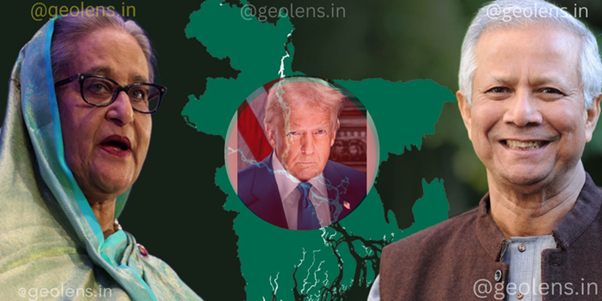
At first glance, Bangladesh appears more stable than many of India’s neighbours. But beneath the surface, political volatility, economic pressure, and external influence are reshaping Dhaka’s strategic posture. In the broader context of India Is Surrounded by Unstable Neighbours, Bangladesh represents a case where instability is latent rather than explosive — and therefore easier to underestimate.
Political Volatility: Power Struggles Beneath Apparent Stability
Although India Is Surrounded by Unstable Neighbours, Bangladesh’s politics remain deeply polarized between rival camps, with institutions frequently drawn into partisan conflict.
Key political dynamics:
- Long-standing tension between ruling and opposition forces continues to erode institutional neutrality.
- Legal cases, arrests, and allegations against senior leaders — including narratives around Sheikh Hasina’s political fate — are increasingly weaponized in public discourse.
- Street protests, shutdowns, and election-related unrest remain recurring features.
Even when the state appears stable, governance legitimacy remains contested, creating openings for external influence and sudden political shifts.
The External Angle: A More Pro-US Strategic Tilt
Recent political signals suggest Bangladesh is seeking greater balance by engaging more closely with the United States and Western partners.
Why this matters:
- Washington views Bangladesh as strategically important in the Bay of Bengal and Indo-Pacific framework.
- Increased U.S. engagement introduces new leverage in Bangladesh’s domestic politics.
- This diversification reduces overdependence on any single external partner — but also complicates India’s traditional influence.
For India, this is not inherently negative, but it demands more active diplomacy, not complacency.
Migration and Demographic Pressure on India
One of the most direct impacts of instability in Bangladesh is cross-border migration, particularly into India’s eastern states.
Challenges for India:
- Economic stress and political uncertainty push migrants toward India.
- Assam, West Bengal, and Tripura face demographic, administrative, and political strain.
- Illegal migration creates internal political friction and security screening challenges.
This is a textbook example of how India Is Surrounded by Unstable Neighbours translates into domestic governance pressure rather than conventional military threat.
Economic Stress and Spillover Risks
Bangladesh’s export-driven economy remains vulnerable to:
- Global demand shocks
- Energy price volatility
- Currency pressure
- Declining foreign reserves during downturns
Any serious economic disruption would immediately spill over into India through migration, border trade disruption, and social pressure along the frontier.
Also Read about- Bangladesh EX-PM Sheikh Hasina Death Sentenced: Turmoil in Bangladesh and Rewired South Asian Politics
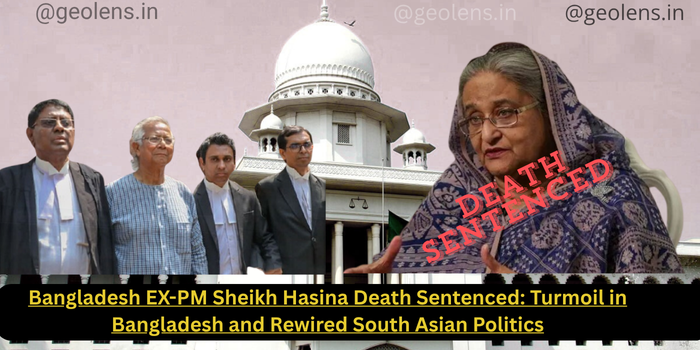
Bangladesh Political Crisis: US Interests, Protests, and the Fall of Sheikh Hasina
Bangladesh went through a major political change after the 2024 unrest, and many people in South Asia believe this change was not only internal but also influenced by external powers — especially the United States.
Bangladesh is strategically important. It sits near the Bay of Bengal, close to India’s northeast, and near major sea routes. Because of this location, the US has long wanted closer security and military cooperation with Bangladesh. There were reports that the US was interested in gaining access to military facilities or setting up a base in the region.
However, when Sheikh Hasina was Prime Minister, she clearly refused to allow any foreign military base on Bangladeshi soil. She followed a balanced foreign policy — maintaining relations with India, China, and the West — but avoided becoming part of any military alliance. This refusal created tension with Washington, even though trade and diplomatic ties continued.
The situation changed in mid-2024 when large student protests broke out across Bangladesh.
How the Protests Started
On July 1, 2024, students at Dhaka University began protesting against the government’s quota system. This system reserved about 30% of government jobs for families of freedom fighters from the 1971 war against Pakistan. Many students felt the system was unfair and blocked opportunities for merit-based selection.
What started as a policy protest quickly spread across the country. As the protests grew, clashes between students and security forces became violent.
Government Crackdown and Violence
The government responded harshly. Police and security forces used force to control the protests. According to various reports, more than a thousand people were killed, and many others were injured or arrested. Internet shutdowns and restrictions on media made the situation worse.
Western countries, human rights groups, and international media strongly criticized the Bangladeshi government. The protests were no longer seen as a domestic issue — they became an international human rights concern.
Allegations of US Involvement
During this period, many analysts in South Asia began questioning the role of the United States. They argue that:
- The US used the violence as a reason to increase diplomatic pressure on Sheikh Hasina.
- Western media and institutions highlighted the crackdown heavily.
- Civil society groups critical of the government received strong international backing.
There is no public proof that the US directly funded or controlled the protests. But critics believe the US supported the pressure campaign that weakened the government’s position internationally.
Fall of the Government and Hasina’s Exit
As pressure increased, Sheikh Hasina reportedly lost support within key state institutions. Facing growing instability and isolation, she was forced to leave Bangladesh. She first sought refuge in India and later moved to the United Kingdom.
Her departure effectively ended her long rule.
Change in Leadership
After her exit, a new political setup emerged that was more acceptable to Western governments. Figures like Muhammad Yunus, who is well-known internationally and respected in Western institutions, became central to the transition.
The new leadership quickly moved to improve relations with the US and reopened discussions on security and strategic cooperation.
Why This Matters
Supporters of the change say it restored democracy and accountability. Critics believe it was an example of indirect regime change, achieved through protests, international pressure, and political isolation rather than a military coup.
Either way, the result is clear: Bangladesh’s political direction has shifted.
For India and South Asia, this episode shows an important reality — political unrest in the region rarely stays internal. Big powers watch closely, influence outcomes quietly, and act when strategic interests are involved.
India Is Surrounded by Unstable Neighbours : Challenges for India
Bangladesh presents India with subtle but persistent challenges:
- Policy unpredictability driven by domestic political churn.
- Migration pressure that becomes politically sensitive inside India.
- Narrative competition, where anti-India rhetoric can be amplified during internal crises.
- Strategic competition, as external powers increase engagement in Dhaka.
The risk is not hostility — it is strategic drift.
Opportunities for India
Despite these challenges, Bangladesh remains one of India’s most important strategic opportunities in South Asia.
Key opportunities:
- Economic integration: Trade, energy cooperation, and connectivity benefit both sides.
- Transit and logistics: Bangladesh is critical to India’s Northeast connectivity.
- Security cooperation: Counter-terror coordination has improved significantly over the years.
- Soft power advantage: Cultural, linguistic, and people-to-people ties still strongly favor India.
Unlike other neighbours, Bangladesh does not require coercion or containment — it requires consistent engagement and respect for autonomy.
Strategic Takeaway
Bangladesh illustrates a crucial point: instability does not always arrive with violence or coups. Sometimes it arrives quietly — through political polarization, economic stress, and external realignment.
For India, Bangladesh’s stability is not optional. It is central to:
- securing the eastern frontier,
- managing migration responsibly, and
- countering external influence without confrontation.
In the larger framework of India Is Surrounded by Unstable Neighbours, Bangladesh is the neighbour where smart diplomacy delivers more security than hard power, and where losing influence would be far more costly than investing to maintain it.
7. Sri Lanka: Economic Collapse, Political Volatility, and the Strategic Cost of Debt Dependency
Sri Lanka is a textbook example of how economic failure can rapidly turn into a strategic liability for neighbouring states. In the larger picture of India Is Surrounded by Unstable Neighbours, Sri Lanka represents instability driven not by war or insurgency, but by financial mismanagement, political fragility, and external debt leverage — particularly from China.
Political Volatility After Economic Collapse

Sri Lanka’s 2022 economic implosion shattered public trust in political leadership and permanently altered its governance landscape.
Key political realities:
- Frequent leadership changes weakened institutional continuity.
- Public anger over inflation, fuel shortages, and debt defaults triggered mass protests.
- Political legitimacy remains fragile, even after stabilization efforts.
- Decision-making is cautious, reactive, and constrained by external creditors.
This volatility does not disappear once protests fade — it lingers beneath the surface.
Economic Fragility and Spillover Risks
Sri Lanka’s economy remains vulnerable despite restructuring efforts.
Structural weaknesses include:
- Heavy dependence on external financing and IMF oversight.
- Limited fiscal space for independent policy decisions.
- High exposure to global commodity and energy price shocks.
- Slow recovery of tourism and export revenues during global downturns.
For India, Sri Lanka’s economic instability matters because collapse does not stay contained on islands.
China’s Debt Trap and Strategic Access
Sri Lanka is often cited as a warning case of debt-driven strategic compromise.
China’s role:
- Large-scale infrastructure loans with limited economic returns.
- Long-term leasing of strategic assets such as Hambantota Port.
- Political leverage gained through financial dependence rather than military presence.
China does not need Sri Lanka to be hostile to India — it only needs Sri Lanka to be financially constrained and strategically permissive.
This is a core reason why India Is Surrounded by Unstable Neighbours is inseparable from China’s economic statecraft.

Migration and Social Pressure
Economic stress in Sri Lanka has historically resulted in outward migration.
Implications for India:
- Increased movement toward southern India during crises.
- Pressure on coastal states and maritime security frameworks.
- Humanitarian considerations complicating security planning.
While not a mass phenomenon today, economic relapse could revive migration flows quickly.
India Is Surrounded by Unstable Neighbours : Challenges for India
Sri Lanka presents India with subtle but high-impact challenges:
- Strategic proximity: Instability in Sri Lanka directly affects India’s southern maritime flank.
- Chinese footprint: Dual-use infrastructure raises long-term security concerns.
- Political sensitivity: Overt pressure risks backlash and nationalist pushback.
- Economic contagion: Financial instability can disrupt regional trade and shipping routes.
The challenge is managing influence without appearing domineering.
India Is Surrounded by Unstable Neighbours : Opportunities for India
Despite the risks, Sri Lanka also offers India meaningful strategic opportunities.
Key opportunities:
- First-responder credibility: India’s assistance during Sri Lanka’s crisis strengthened trust and goodwill.
- Economic integration: Energy, power grids, ports, and logistics cooperation benefit both sides.
- Maritime security leadership: India can anchor stability in the Indian Ocean through cooperation, not coercion.
- Alternative to China: India can offer transparency, sustainability, and autonomy — not debt dependency.
Unlike China, India’s advantage lies in predictability and proximity, not capital volume.
Strategic Takeaway
Despite India Is Surrounded by Unstable Neighbours, Sri Lanka proves that instability does not always wear a uniform or carry a gun. Sometimes it arrives through balance sheets, bond markets, and broken governance.
For India, Sri Lanka’s stability is essential to:
- securing the Indian Ocean periphery,
- limiting external military access near its coastline, and
- preventing economic crises from becoming strategic crises.
In the broader framework of India Is Surrounded by Unstable Neighbours, Sri Lanka is the reminder that economic collapse can be just as destabilizing as conflict, and that smart economic diplomacy is as critical as military preparedness.
8. Maldives: Political Opportunism, China’s Shadow, and India’s Strategic Restraint
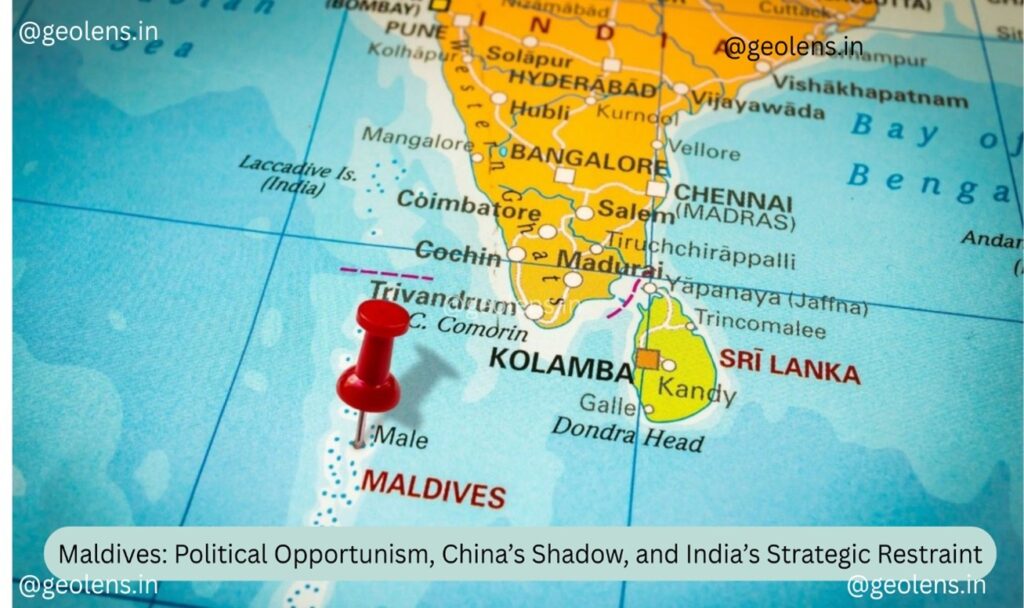
Among India’s smaller neighbours, Maldives punches far above its weight strategically. In the wider context of India Is Surrounded by Unstable Neighbours, Maldives illustrates how electoral politics, external influence, and geographic leverage can turn a tiny island nation into a serious strategic variable.
The ‘India Out’ Campaign and Electoral Politics
By though India Is Surrounded by Unstable Neighbours the rise of the Muizzu government was closely tied to an aggressive “India Out” political campaign, which framed India’s presence as interference rather than assistance.
Key dynamics behind the campaign:
- India was portrayed as undermining Maldivian sovereignty for electoral gain.
- Indian military personnel and development projects were politicized.
- Anti-India rhetoric was amplified on social media and through aligned political messaging.
This campaign was less about policy and more about mobilizing nationalism to win elections.
Once in power, however, ideological rhetoric quickly collided with economic and governance realities.
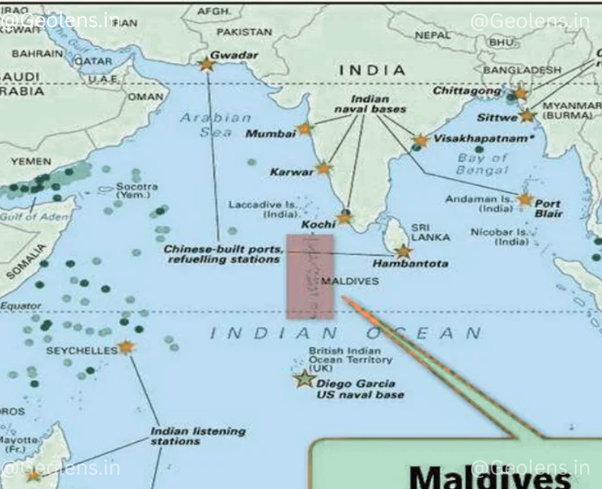
Strategic Drift Toward China
After assuming office, the Muizzu administration signaled a foreign policy tilt toward China.
Indicators of this shift:
- Warmer diplomatic engagement with Beijing.
- Renewed interest in Chinese-funded infrastructure projects.
- Public messaging that emphasized “strategic autonomy” while quietly increasing dependence.
China’s appeal is straightforward: no political questions, fast capital, and strategic ambiguity.
But this approach carries long-term risks that Maldives has neither the scale nor resilience to absorb alone.
Reality Check: Dependency on India
Despite political posturing, Maldives’ structural dependence on India remains unchanged.
When pressure mounts, Maldives turns to India for:
- Financial assistance to stabilize budgets and foreign exchange reserves.
- Medical aid, including emergency evacuations and healthcare access.
- Humanitarian and disaster relief, especially during water shortages and climate-related emergencies.
- Security and maritime support, including surveillance and capacity building.
When rhetoric ends, India becomes the default safety net.
This contradiction defines Maldives’ foreign policy behavior.
Why India Still Helps — Despite the Provocations
India Is Surrounded by Unstable Neighbours. It is cold strategic calculation.
India understands that abandoning Maldives creates a vacuum — and vacuum is always filled by bigger players, whether China or, indirectly, extra-regional powers like the United States.
India’s core interests in Maldives:
- Preventing hostile or dual-use military presence near key sea lanes.
- Securing India’s western Indian Ocean approaches.
- Maintaining regional stability without overt coercion.
- Ensuring Maldives does not become a bargaining chip in great-power competition.
This is why India absorbs political hostility and still delivers assistance.
India Is Surrounded by Unstable Neighbours: Challenges for India
Maldives presents India with persistent challenges:
- Political unpredictability: Governments can flip policy direction overnight.
- Anti-India narratives: Easily mobilized during election cycles.
- Chinese strategic encroachment: Infrastructure today, leverage tomorrow.
- Limited leverage: Excess pressure risks backlash; too little invites drift.
India must influence without appearing dominant — a narrow and difficult path.
India Is Surrounded by Unstable Neighbours : Opportunities for India
Despite tensions, Maldives still offers India strategic openings.
Key opportunities:
- People-to-people trust: Public dependence on Indian healthcare and services remains strong.
- Security cooperation: Maritime surveillance and disaster response create long-term alignment.
- Economic integration: Energy, tourism logistics, and connectivity reduce external dependency.
- Strategic patience: India’s reliability contrasts sharply with China’s transactional approach.
India’s strength lies in being present, predictable, and unavoidable.
Strategic Takeaway
Maldives is not anti-India by design — it is opportunistic by necessity. Its leaders exploit nationalism domestically while relying on India externally.
In the broader reality that India Is Surrounded by Unstable Neighbours, Maldives shows how small states weaponize geography and elections, forcing India to practice restraint, patience, and long-term thinking.
India’s approach toward Maldives is a preview of its future regional strategy:
absorb noise, deny vacuums, and secure interests without escalation.
PART- 2 :Author’s Viewpoint: Why India Is Still Rising Despite Being Surrounded by Instability
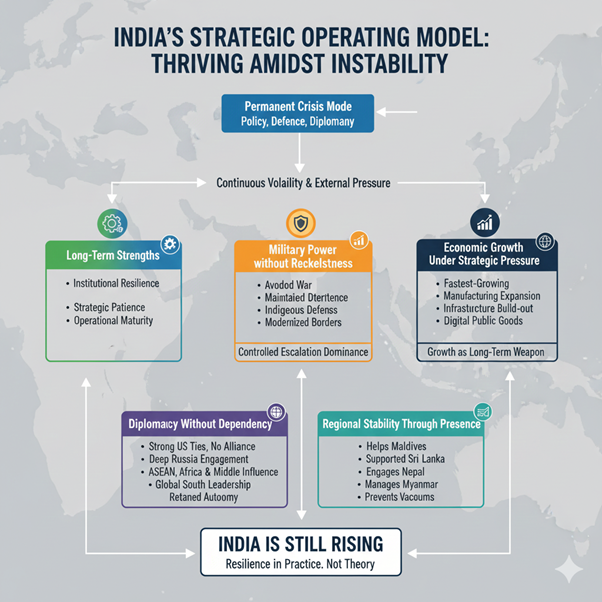
The most important thing to understand is this:
India’s rise is not happening because its neighbourhood is stable — it is happening despite the opposite.
Very few major powers in history have grown while being simultaneously surrounded by unstable, hostile, or externally manipulated neighbours on almost every frontier. India is doing exactly that.
Being in a region where Pakistan weaponizes instability, Afghanistan has collapsed, China applies systematic pressure, and smaller neighbours oscillate between dependency and opportunism, India has had no luxury of ideal conditions. Instead, it has been forced to mature faster than it otherwise would have.
What looks like a burden has quietly become a strategic forcing function.
India Has Learned to Operate in Permanent Crisis Mode
India Is Surrounded by Unstable Neighbours no longer plans for a “peaceful neighbourhood” scenario — because that scenario does not exist. Policy-making, defence planning, and diplomacy are now designed around continuous volatility.
This has produced three long-term strengths:
- Institutional resilience: Indian systems are stress-tested constantly.
- Strategic patience: India absorbs provocation without panic.
- Operational maturity: From counter-terror to maritime security, India acts with calibrated force, not impulse.
Many countries talk about resilience. India practices it daily.
Military Power Without Recklessness
India Is Surrounded by Unstable Neighbours despite managing two active fronts — Pakistan and China — India has:
- Avoided large-scale war
- Maintained deterrence
- Expanded indigenous defence production
- Increased defence exports
- Modernized border infrastructure at unprecedented speed
This is not stagnation. This is controlled escalation dominance.
India has moved from reactive defence to cost-imposition strategy, as seen in surgical operations, intelligence-driven actions, and strategic levers like water, trade, and technology controls.
Economic Growth Under Strategic Pressure
Historically, sustained external pressure slows economic growth. India has broken that pattern.
Even while being surrounded by unstable neighbours:
- India remains one of the fastest-growing major economies
- Manufacturing is expanding due to global China-plus-one strategies
- Infrastructure build-out continues at scale
- Digital public goods (UPI, Aadhaar, ONDC) are becoming global models
This is not accidental. It is the result of strategic clarity — India knows growth is its strongest long-term weapon.
Diplomacy Without Dependency
India Is Surrounded by Unstable Neighbours something rare:
It has increased its global relevance without becoming a formal ally or satellite of any power bloc.
- Strong ties with the US, but no alliance
- Deep engagement with Russia, without dependency
- Growing influence in ASEAN, Africa, and the Middle East
- Leadership roles in the Global South
In a region full of countries trapped by foreign leverage, India stands out precisely because it retains autonomy.
Regional Stability Through Presence, Not Domination
India Is Surrounded by Unstable Neighbours It tries to prevent vacuums.
This is why:
- India keeps helping Maldives despite political hostility
- India supported Sri Lanka during economic collapse
- India engages Nepal quietly rather than coercively
- India manages Myanmar with security realism, not moral absolutism
This approach is slower, messier, and often thankless — but it works.
Conclusion: Instability Around India Is Not Slowing Its Rise — It Is Defining It
The phrase “India Is Surrounded by Unstable Neighbours” is often used as a warning. In reality, it is a description of the strategic environment that has shaped modern India.
Yes, the challenges are real:
- Multi-front security pressure
- Terrorism and insurgency spillovers
- Migration and demographic stress
- China’s long-term encirclement strategy
- Political volatility next door
But the response matters more than the challenge.
India has chosen:
- Preparation over panic
- Balance over alignment
- Growth over grievance
- Stability over domination
Unlike its neighbours, India does not rely on chaos for relevance.
Unlike China, it does not seek dominance through dependency.
Unlike many powers, it plays a long game measured in decades, not headlines.
If India reaches superpower status in the coming decades — and all indicators suggest it will — it will not be because the neighbourhood was friendly.
It will be because India learned how to grow, defend, and lead in one of the world’s most unstable regions — and turned that pressure into strategic strength.
In that sense, being surrounded by unstable neighbours is not India’s weakness.
It is the environment that is forging India into a far more resilient, capable, and consequential power than it would have been otherwise.

Pratik Kondawale
Strategist | Indian Defence & Global Affairs
Founder of GeoLens.in, Pratik writes in-depth analysis on India’s defence strategy, military tech, and global power shifts delivering sharp insights through an Indian lens.

Almost 8.5 million Joins : “No king Protest in USA” against Trump
The No king Protest in USA has drawn nearly 8.5 million people across America and Europe, uniting voices against authoritarianism and Trump’s Iran war policies. With over 3,000 demonstrations in U.S. cities and solidarity marches abroad, the movement highlights concerns about unchecked executive power, democratic erosion, and humanitarian fallout. Diverse groups—students, civil rights activists, labor unions, and grassroots coalitions—have joined forces in a decentralized, digitally coordinated campaign. More than an anti‑war protest, it is a call to defend democracy, protect civil rights, and resist authoritarian tendencies

“Will shoot first, ask questions later.” Why Trump wants Greenland and why it is so important ? In 2026
Why Trump wants Greenland and why it is so important goes far beyond a controversial proposal or diplomatic provocation. Greenland sits at the center of a rapidly militarizing Arctic, rich in critical minerals, emerging sea routes, and strategic military value.
Trump’s interest reflects deeper U.S. concerns over national security, Russian and Chinese Arctic expansion, and long-term control over resources that underpin global economic power. Denmark’s unusually harsh military warning shows this is not political theater but a genuine sovereignty crisis. As climate change unlocks Arctic access, Greenland has become a frontline in great-power rivalry, where a single miscalculation could fracture NATO, destabilize global markets, and reshape the world order.

Operation Absolute Resolve: How the U.S. Capture of Nicolás Maduro Reshaped Global Geopolitics
Operation Absolute Resolve marks one of the most controversial U.S. military actions in recent history. In January 2026, American forces reportedly captured Venezuelan President Nicolás Maduro and transferred him to U.S. custody, triggering global shock and debate. Officially justified by national security, narco-terrorism, and migration concerns, the operation is widely seen by analysts as driven by deeper geopolitical motives—especially Venezuela’s vast oil reserves and its alignment with U.S. rivals. This article examines how Operation Absolute Resolve unfolded, the legal and strategic risks it poses, global reactions, and what the crisis means for India and the future of international order.

India Is Surrounded by Unstable Neighbours — What are the Real Challenges and Opportunities Does This Create?
India Is Surrounded by Unstable Neighbours, a reality that is steadily shaping its strategic environment. Political turmoil, economic collapse, military dominance, and external interference across South Asia create constant pressure on India’s borders and internal security. Yet, this instability also forces New Delhi to adapt—by strengthening defence preparedness, expanding diplomatic influence, securing trade routes, and positioning itself as a stabilizing power in the region. This article examines the real challenges India faces and the strategic opportunities emerging from a volatile neighbourhood.

Tejas Crash at Dubai Air Show 2025 — A Tragedy, A Lesson, and A Call for Reform
The Tejas crash at the Dubai Air Show turned a moment of national pride into sudden heartbreak when Wing Commander Syal lost his life. This article unpacks the events of that day, explains why the Tejas crash matters for India’s defense readiness, and outlines the practical lessons and reforms needed to ensure the program recovers stronger. It also honors the pilot’s sacrifice and shows how the Tejas crash can become a catalyst for accountability, safer engineering, and faster delivery of operational jets.

Bangladesh EX-PM Sheikh Hasina Death Sentenced: Turmoil in Bangladesh and Rewired South Asian Politics
The Sheikh Hasina death sentenced verdict has detonated one of the most explosive political crises in Bangladesh’s modern history. Delivered in absentia by the International Crimes Tribunal, the ruling blames the former prime minister for orchestrating widespread state violence during the 2024 student protests. The decision has dismantled the Awami League’s long-standing dominance, pushed Bangladesh into a volatile power vacuum, and placed India in the middle of a diplomatic standoff. As questions about justice, political motivation, and regional stability collide, the fallout of this verdict is reshaping South Asian geopolitics in real time.
1 thought on “India Is Surrounded by Unstable Neighbours — What are the Real Challenges and Opportunities Does This Create?”