Breaking: US B-2 Bombers Strike Iran’s Nuclear Sites – Global Shockwaves Explained
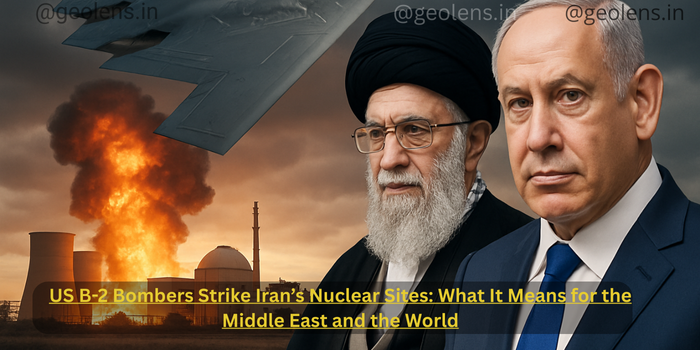
In a bold and highly secretive operation US B-2 bombers strike Iran, the United States has launched precision airstrikes on Iran’s underground nuclear facilities—with tremors felt not just in Tehran but across the region. The targets? Iran’s most fortified nuclear development centers: Fordow, Natanz, and Isfahan. The aftermath has been immediate. Sirens blared across Israeli cities after multiple blasts were reported, likely in response to Iranian missile retaliation or failed interceptions.
This was no ordinary strike. It was a stealth attack carried out by the world’s most advanced bomber—the U.S. B-2 Spirit—carrying 30,000-pound bunker-busting bombs deep into Iran’s nuclear heartland.
Table of Contents
The Bigger Picture: A New Type of Warfare: This US B-2 bombers strike Iran wasn’t just military—it was strategic: Cyber warfare, Electronic jamming, Psychological pressure, Long-range stealth tactics
It signals a shift to covert precision warfare, where technology, misinformation, and stealth dominate the battlefield. It also sends a message to other powers—North Korea, Russia, China—that underground weapons programs are vulnerable, no matter how deep or fortified.
Donald Trump Reacts to U.S. Strike on Iran | June 22, 2025
This video shows U.S. President Donald Trump’s official reaction following the recent US B-2 bombers strike Iran’s nuclear sites, reportedly involving B-2 bombers and deep-strike munitions. His statement has sparked global discussions on America’s foreign policy shift and its implications on Middle East stability.
Soon after US B-2 bombers strike Iran, Russia has long supported Iran’s nuclear development diplomatically, Moscow has issued a carefully worded statement urging restraint. Behind closed doors, Russian defense analysts are likely studying the implications of U.S. radar-jamming technologies and decoy strategies used in the strike.
This operation exposed the ineffectiveness of integrated defense systems, even those supported by Russian and Chinese hardware. For Russia, this might trigger a review of radar architecture and early-warning alliances with Iran and Syria.
Beijing, deeply invested in the Belt and Road projects in Iran, has expressed “grave concern” about rising instability. China is one of the largest importers of Iranian oil, and any military escalation that disrupts oil flow through the Strait of Hormuz could severely impact Chinese industries and inflation.
Moreover, the US B-2 bombers strike Iran, airstrike challenges China’s own underground weapons programs. Experts believe the U.S. strike was also a message to Beijing: deep bunkers and secrecy are no longer guarantees of safety.
Video Source: Times Now/YouTube
The Psychological Warfare Angle: A Strike Meant to Deter
Beyond physical destruction, the mission had a psychological objective. U.S. military strategists wanted to demonstrate that stealth aircraft and B-2 bunker-busters can overcome any depth, misdirection, or international support.
Military analysts call this “deterrence by demonstration.” It sends a clear signal to:
North Korea: your tunnels and bunkers aren’t safe.
Russia: we can strike before your radars see us.
China: your cyber and radar alliances with Iran have limits.
Expert Analysis: on US B-2 bombers strike Iran, Was This a One-Off or Phase One?
According to retired U.S. Air Force General Thomas Keane:
“The US B-2 bombers strike Iran, strike isn’t just about Iran—it’s a military blueprint being tested live. Expect rehearsals, not conclusions.”
Many defense experts believe this operation is Phase One of a broader U.S. doctrine shift: integrating stealth, misinformation, and long-range bombing as a first-strike strategy in geopolitical hotspots.
Public Sentiment: America Divided, Iran Unites
🇺🇸 In the U.S.: Divided Reactions
While conservative media hailed the precision on US B-2 bombers strike Iran, as a show of strength, anti-war critics questioned the lack of Congressional approval and the risk of sparking a regional war.
Protests have erupted in several American cities, with slogans like “No more endless wars” and “Not in our name.”
🇮🇷 In Iran: Nationalism Surges
Despite heavy damage, the Iranian regime is using the strike to unite the public. Iranian media portrays the U.S. as “the aggressor,” and religious leaders have called for “a second revolution against Western imperialism.”
What’s Next? Scenarios to Watch Closely
1. Retaliation in the Strait of Hormuz
Iran may deploy naval mines or drones to disrupt oil shipping routes, in the retalisation of US B-2 bombers strike Iran.
U.S. and allied navies are on high alert near Bahrain and Qatar.
2. Cyber Retaliation
Iranian cyber units could launch attacks on Western financial, oil, or defense systems—similar to the Shamoon virus era.
3. Proxy Escalation via Hezbollah or Houthis
Iran may avoid direct confrontation and instead activate regional proxies to hit Israeli or U.S. targets.
Author’s Viewpoint
The “US B-2 bombers strike Iran” marks a clear turning point: the United States has moved from waiting and watching to taking direct, high-stakes military action to halt what it sees as a climatic threat from Iran’s nuclear programme. It sees the operation not just as a tactical hit on underground facilities but as a strategic message — that the U.S. (and by extension its allies) will use deep-strike capabilities and take on hardened, hidden targets if necessary.
In my point of view, this is both a necessity (because Iran’s breakout potential was nearing a red line) and a gamble (because it shifts the risk of escalation sharply upward). In plain terms: the strike says, “We can reach you, even underground, and we’re willing to act.” But it also says, “Once we act, we enter into the risk of full-blown regional war.”
US B-2 bombers strike Iran: What Are the Geopolitical Actions Ahead (in the Iran-Israel angle)
Iran will almost certainly respond — probably not with a symmetric “we bomb you back” strike inside the U.S., but through proxies (in Iraq, Syria, Lebanon), missile/drone attacks on shipping or bases in the Gulf, or covert sabotage.
For Israel, the operation reinforces its preferred strategy: push the U.S. to act, use its own air-power and intelligence to weaken Iran’s nuclear programme, and rely on American global reach to clinch the hardest targets. Israel’s role becomes more of a partner and trigger-puller in the broader US-led effort.
The Middle East enters a more volatile phase: tighter US-Iran confrontation, the possibility of mis-calculation becoming open war, greater risk to oil-routes (Strait of Hormuz, Red Sea), and destabilisation in neighbouring states (Gulf monarchies, Iraq).
Diplomacy will now likely be two-fold: Iran may be driven back to negotiate under pressure, but the terms will be tougher. At the same time, regional powers will scramble: either to hedge (build deeper bunkers, missile defences) or to align (seek US backing, hedge against Iran).
For non-state actors and proxy forces aligned with Iran (and Israel),this opens a broader battlefield: from Lebanon/Hezbollah, Yemen/Houthis, to maritime attacks, cyber or covert operations. In short: the kinetic phase is now more than “just Iran’s nuclear site”.
On the non-proliferation front, the precedent matters: a major power striking deeply buried nuclear infrastructure sets a signal to other states that time-bound and transparent programmes are vulnerable. That may push states to further hide capabilities, disperse assets, or accelerate breakout timelines.
Lessons for India after US B-2 bombers strike Iran
Watch strategic break‐points before they force action. India must learn when adversaries approach irreversible thresholds (for example, Pakistan or China’s developments) and ensure it has both early-warning and credible deterrent options.
Build and make visible credible strike depth. The strike shows that conventional defences, bunkers and deep sites aren’t safe by default. India must maintain visible strike capabilities (missiles, submarines, long-reach bombers) so that its deterrent isn’t only defensive.
Manage escalation. Taking the first strike brings massive escalation risk. India must build scenarios not just for when to strike, but how to manage blowback: proxies, maritime-chokepoints, energy shocks.
Independence of action matters. The U.S. leveraged global logistics, air‐refuelling, stealth bombers. India must work on infrastructure, alliances, and platforms so it isn’t left waiting while big powers act.
Regional ripple effects are real. Instability in the Middle East affects India: oil import vulnerability, diaspora security, shipping lanes, defence supply chains. India must hedge accordingly (storage, alternate routes, diversified supplies).
Signal matters as much as capability. The “US B-2 bombers strike Iran” message was partly about capability (deep strike) and partly about will. India must convey both: that it can act, and that it will.
Conclusion: A New Era of Shadow Conflict Begins
The US B-2 bombers strike on Iran was more than a precision mission—it was a declaration of strategic intent.
This operation marks a transition from traditional warfare to a tech-driven conflict theater, where invisibility, misinformation, and precision dominate.
The world now watches Iran’s next move. The only certainty: the Middle East has entered a new, volatile phase, and the global balance of power will never be the same again.
Stay tuned for more updates and analysis here on The GeoLens.
Final Thoughts: Middle East on the Edge With Israel relieved, Iran fuming, and global oil markets trembling, the next few days are critical.
Will Iran retaliate with direct strikes? Will they block Hormuz? Will global powers intervene?
The only certainty: The balance of power in the Middle East has just shifted.
Stay tuned to The GeoLens for deep, unbiased, and expert coverage of global conflicts.
What is India’s 5th Generation Fighter Jet AMCA: Where We Stand, Challanges, & Way Ahead
In a sky dominated by stealth and speed, India can no longer afford to chase shadows—it must become the shadow.
Founder of GeoLens.in, Pratik writes in-depth analysis on India’s defence strategy, military tech, and global power shifts delivering sharp insights through an Indian lens.
Why Trump wants Greenland and why it is so important goes far beyond a controversial proposal or diplomatic provocation. Greenland sits at the center of a rapidly militarizing Arctic, rich in critical minerals, emerging sea routes, and strategic military value.
Trump’s interest reflects deeper U.S. concerns over national security, Russian and Chinese Arctic expansion, and long-term control over resources that underpin global economic power. Denmark’s unusually harsh military warning shows this is not political theater but a genuine sovereignty crisis. As climate change unlocks Arctic access, Greenland has become a frontline in great-power rivalry, where a single miscalculation could fracture NATO, destabilize global markets, and reshape the world order.
Operation Absolute Resolve marks one of the most controversial U.S. military actions in recent history. In January 2026, American forces reportedly captured Venezuelan President Nicolás Maduro and transferred him to U.S. custody, triggering global shock and debate. Officially justified by national security, narco-terrorism, and migration concerns, the operation is widely seen by analysts as driven by deeper geopolitical motives—especially Venezuela’s vast oil reserves and its alignment with U.S. rivals. This article examines how Operation Absolute Resolve unfolded, the legal and strategic risks it poses, global reactions, and what the crisis means for India and the future of international order.
India Is Surrounded by Unstable Neighbours, a reality that is steadily shaping its strategic environment. Political turmoil, economic collapse, military dominance, and external interference across South Asia create constant pressure on India’s borders and internal security. Yet, this instability also forces New Delhi to adapt—by strengthening defence preparedness, expanding diplomatic influence, securing trade routes, and positioning itself as a stabilizing power in the region. This article examines the real challenges India faces and the strategic opportunities emerging from a volatile neighbourhood.
The Tejas crash at the Dubai Air Show turned a moment of national pride into sudden heartbreak when Wing Commander Syal lost his life. This article unpacks the events of that day, explains why the Tejas crash matters for India’s defense readiness, and outlines the practical lessons and reforms needed to ensure the program recovers stronger. It also honors the pilot’s sacrifice and shows how the Tejas crash can become a catalyst for accountability, safer engineering, and faster delivery of operational jets.
The Sheikh Hasina death sentenced verdict has detonated one of the most explosive political crises in Bangladesh’s modern history. Delivered in absentia by the International Crimes Tribunal, the ruling blames the former prime minister for orchestrating widespread state violence during the 2024 student protests. The decision has dismantled the Awami League’s long-standing dominance, pushed Bangladesh into a volatile power vacuum, and placed India in the middle of a diplomatic standoff. As questions about justice, political motivation, and regional stability collide, the fallout of this verdict is reshaping South Asian geopolitics in real time.
China’s new air defence near Pangong marks a major strategic escalation in the Himalayas. Satellite imagery reveals advanced HQ-9 missile systems, radar units, and fortified shelters aimed at asserting Chinese air dominance over eastern Ladakh. This development not only alters the regional military balance but also raises critical questions about India’s preparedness, response strategy, and the long-term implications for border security and geopolitical stability in South Asia.





1 thought on “US B-2 Bombers Strike Iran’s Nuclear Sites: What It Means for the Middle East and the World”