
BRICS Summit 2025: India’s Role in Leading Global South Leadership

Facebook
X
WhatsApp
Threads
LinkedIn
Reddit

Table of Contents

BRICS Summit 2025 , held against the backdrop of economic uncertainty, geopolitical rivalry, and calls for institutional reform, marked a pivotal moment for the group. At the center of it all was India, a nation increasingly seen as a bridge between East and West — a democratic powerhouse with growing economic and diplomatic clout.

Introduction: What is BRICS & BRICS Summit

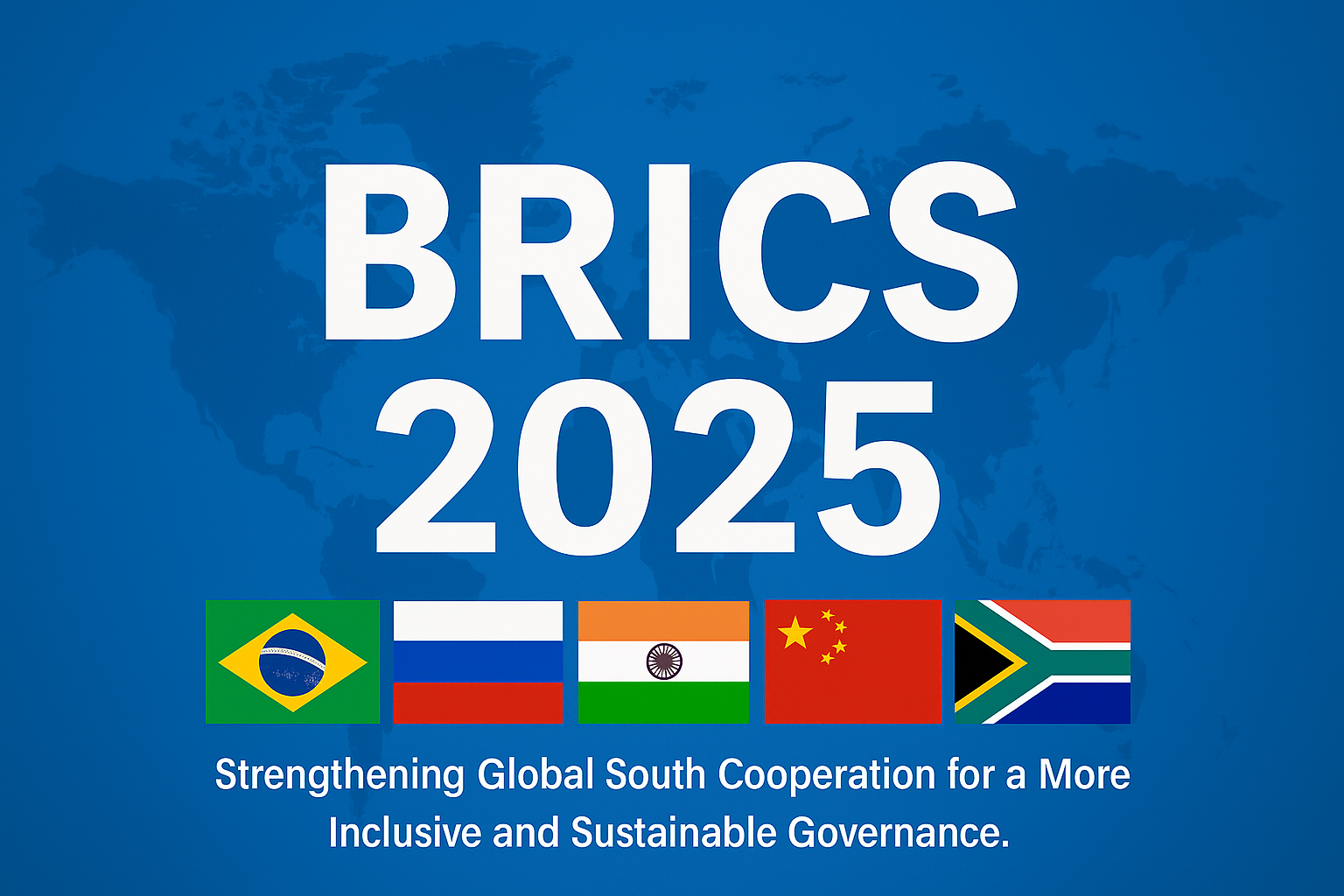
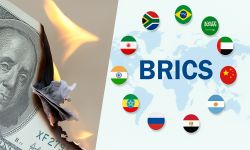
BRICS is an acronym for Brazil, Russia, India, China, and South Africa. Headquartered in Shanghai (China) a group of major emerging economies that came together to promote economic cooperation, multipolar global governance, and reform of Western-dominated institutions like the IMF and World Bank. The bloc now represents approximately 49.5% of the world’s population, 40% of global GDP, and 26% of global trade. And in 2014 BRICS establishes New Development Bank Headquartered in Shanghai (China)

The term “BRIC” was first coined by Goldman Sachs economist Jim O’Neill in 2001, predicting that these countries would become dominant economic powers in the 21st century.

In 2009, the first official BRIC summit was held in Russia, formalizing the group’s existence as a political and economic bloc.

South Africa joined in 2010, turning BRIC into BRICS.

Initially seen as a symbolic coalition of fast-growing economies, BRICS gradually transformed into a geopolitical force that challenged Western dominance in global decision-making.

BRICS Summit 2025 (Expansion in 2024–2025)

In the 15th BRICS Summit (Johannesburg, 2023), all the leaders agreed on expansion policy for the betterment. In 2024, BRICS welcomed the following countries:

  • Egypt
  • Ethiopia
  • Iran
  • Saudi Arabia
  • United Arab Emirates (UAE)

What was BRICS Summit 2025 all about?

The BRICS summit 2025, hosted by Brazil in Rio de Janeiro, Brazil, on July 6-7, focusing on strengthening cooperation among Global South countries, aimed to chart a new direction for the bloc amid mounting global challenges.

11 new BRICS partner countries welcomed – Belarus, Bolivia, Kazakhstan, Cuba, Nigeria, Malaysia, Thailand, Vietnam, Uganda, Uzbekistan.

Theme: Strengthening Global South Cooperation for a More Inclusive and Sustainable Governance”.

BRICS summit 2025 was focus on several important topics

  • Global Health: The countries will work together to make sure everyone has fair access to medicines and vaccines, and to better handle health problems around the world.
  • Trade and Economy: A major goal is to create a common BRICS currency and reduce dependence on the US dollar. This would help member countries become more financially independent.
  • Climate Change: The summit will push for a shared plan called the BRICS Climate Leadership Agenda to promote sustainable practices and tackle climate-related issues together.
  • Artificial Intelligence (AI): Leaders will talk about creating fair and inclusive rules for using AI, so all countries benefit from this technology.
  • Peace and Security: The group aims to improve the global peace system by pushing for reforms that support stability and cooperation.
  • BRICS Internal Development: The summit also plans to strengthen how BRICS operates as a group, especially now that it has more members, to ensure better coordination and decision-making.

India’s Role in BRICS Summit 2025

India`s Role into BRICS Summit 2025, was to face a delicate balancing act. On one hand, it enjoys strategic partnerships with the United States, Japan, and Europe through the QUAD and G20. On the other, it remains a founding member of BRICS and has advocated for a multipolar world where the voices of developing nations are heard.

Key Indian objectives ahead of the summit included:

  • Promoting rupee-based trade within BRICS summit 2025
  • Opposing the weaponization of economic sanctions
  • Enhancing digital public infrastructure sharing
  • Curbing Chinese dominance in institutional decision-making

India’s foreign policy is defined by strategic autonomy which allowed it to speak with clarity, emphasizing collaboration without domination.

  • Voice for Developing Countries
    Prime Minister Modi strongly spoke about the need to reform big global organizations like the UN, IMF, and World Bank so they treat all countries fairly, especially those from the Global South (developing nations).

  • Focus on Peace and Security
    India asked all BRICS nations to stand together against terrorism and promote peace in the world. PM Modi also condemned recent terrorist attacks and called for unity in fighting such threats.

  • Support for BRICS Currency & Trade in Local Money
    India supported using local currencies for trade instead of always relying on the US dollar. This helps BRICS countries become more financially independent.

  • Encouraging Responsible AI Use
    India shared ideas on how to use Artificial Intelligence (AI) wisely and safely. It also proposed creating a shared database for science and innovation and stressed the need for strong supply chains in critical areas like minerals and tech.

  • Promoting Climate Justice
    PM Modi called climate action a “moral responsibility” and encouraged eco-friendly development. India supported the BRICS Climate Leadership Agenda to fight climate change together.

  • Smart Diplomacy and Partnerships
    India had friendly meetings with other countries like Brazil and China to discuss digital payments (like UPI), climate efforts, trade, and future cooperation. These talks also helped prepare India for hosting the next BRICS summit in 2026.

Sorce PMO office. 

How BRICS Summit 2025 & BRICS+ are reshaping the world order

BRICS+ means the expanded version of BRICS, with more countries like Egypt, Ethiopia, Iran, and others joining.
This group is becoming stronger not only in trade, energy, technology, but also in global decision-making.

How it changes the world:

  • It reduces Western (mainly U.S. and European) control over global affairs.

  • It gives developing countries more say in global issues.

  • It creates an alternative to Western-led groups like the G7 or NATO.

  • It promotes trade in local currencies instead of depending on the U.S. dollar.

In short: BRICS+ gives the Global South a louder voice in shaping the future.

Why the US is Against BRICS

The U.S. is not officially against BRICS, but form the back door it is clearly sees it as a challenge because Dollar dominance is at risk: BRICS wants to trade without using the dollar, which weakens U.S. economic power. And in the Global influence BRICS is trying to build its own world order, which could reduce U.S. political influence over time. Watching closely we can clearly make out that Allies of the USA are more keen towards joining BRICS, Some U.S. allies or trade partners are showing interest in BRICS+, which worries Washington.

In short: The U.S. sees BRICS as a competitor that’s changing the rules of the global game.

India vs China in BRICS summit 2025: Rivalry or Strategic Realignment?

India and China have both common goals and yet so far serious differences. Such Common Goals we witness those are challenge to the Western dominance, promote development, and support the Global South. Both the countries are mountainously Rivalry at some point or other as they compete for leadership within BRICS and have border tensions. China often supports Pakistan, which India doesn’t like. And coming to the Realignment part, Despite their issues, both cooperate in BRICS to uplift the global influence and work on shared interests like climate change and trade reforms.

In short: It’s a mix of competition and cooperation — more like “friendly rivals” with shared goals.

Strategic Gain for India from BRICS summit 2025

India gained several key advantages staring from the very first Global Leadership Role, India positioned itself as a voice of the Global South and called for reforms in global systems. Financial Advantage India supported alternatives to the dollar and strengthened its role in BRICS financial systems. AI and Innovation: India promoted ethical use of AI and became a tech leader among developing nations. Diplomatic Wins: India built stronger ties with countries like Brazil, Iran, and South Africa—expanding its influence ahead of BRICS 2026 (which India will host).

In short: India improved its global image, boosted economic strategy, and gained momentum for 2026.

What This Means for India’s Foreign Policy in BRICS Summit 2025

India’s BRICS involvement shows a clear shift in its foreign policy by presenting a Balanced Diplomacy approach to maintain good relations with both the West (like the U.S.) and the Global South. Managing a Multi-alignment Strategy is something Instead of picking one side, India wants to work with all major powers to benefit its people and economy. Focus on a Stronger Global Role India is moving from being just a participant to becoming a shaper of global rules especially when it comes to finance, tech, and climate.

In short: India’s foreign policy is now about smart balancing, stronger leadership, and serving national interest through global cooperation.

Conclusion

BRICS summit 2025 proved that India doesn’t need to dominate to lead. Its success lies in offering practical solutions, maintaining diplomatic poise, and amplifying the concerns of developing nations.

As BRICS moves toward expansion, de-dollarization, and structural reform, India has the opportunity to shape the bloc’s moral and strategic compass — not by force, but through vision and credibility.

The world is watching. And India, it seems, is ready to lead — the BRICS way.

FAQs

Q1. What happened at the BRICS 2025 summit?
The summit focused on expansion, reducing dollar dependence, tech collaboration, and empowering the Global South. Nine countries now make up BRICS.

Q2. What role did India play in BRICS 2025?
India was central in shaping digital, trade, and institutional reform agendas, and promoted inclusive multipolar leadership.

Q3. Did BRICS 2025 agree on a new currency?
A framework for local currency trade was introduced, but no common BRICS currency was finalized.

Q4. How did India and China interact during BRICS?
They cooperated on reforms but clashed subtly on leadership dynamics, digital currency, and bloc expansion terms.

Q5. What’s next for India in BRICS?
India is expected to host or co-lead future initiatives and play a stronger role in BRICS+ diplomacy, especially in Africa and Latin America.

People Also Ask BRICS Summit 2025

  1. How is India emerging as a leader of the Global South through BRICS?
    India is positioning itself as the collective voice of developing nations by advocating fair global governance, equitable growth, and stronger South-South cooperation within BRICS. The summit highlights India’s diplomatic maturity and increasing influence in shaping the Global South’s agenda.

  2. What were India’s major priorities at the BRICS 2025 Summit?
    India focused on global governance reforms, financial inclusion, resilient supply chains, technology collaboration, and strengthening the role of BRICS in international decision-making — especially regarding development finance and trade.

  3. Why is reforming the IMF and World Bank important for India and BRICS nations?
    These institutions are seen as dominated by Western countries. India wants rebalanced voting rights and decision power so that emerging economies get fair representation, aligning financial governance with today’s global economic reality.

  4. How does India benefit from local currency trade within BRICS?
    Local currency transactions reduce dependency on the US dollar, lower currency fluctuation risks, and make trade more affordable for developing economies. For India, it supports economic sovereignty and strengthens its financial positioning in global markets.

  5. What is India’s future role in BRICS as chair in 2026?
    India aims to push forward initiatives like digital public infrastructure, climate finance, defence-tech cooperation, and expanded Global South participation. Its chairmanship will be a chance to turn policy proposals into solid frameworks that boost BRICS’ global relevance.

“New Delhi’s diplomacy is the new compass of the Global South.”

China`s Mosquito Spy Drone: What It Means for India’s Security

Mosquitoes are no longer limited to households; they have now become a matter of national security.

|The GeoLens – Indian Defense & Global Affairs

Picture of Pratik Kondawale

Pratik Kondawale

Strategist | Indian Defence & Global Affairs

Founder of GeoLens.in, Pratik writes in-depth analysis on India’s defence strategy, military tech, and global power shifts delivering sharp insights through an Indian lens.

All Posts

“Will shoot first, ask questions later.” Why Trump wants Greenland and why it is so important ? In 2026

Why Trump wants Greenland and why it is so important goes far beyond a controversial proposal or diplomatic provocation. Greenland sits at the center of a rapidly militarizing Arctic, rich in critical minerals, emerging sea routes, and strategic military value.

Trump’s interest reflects deeper U.S. concerns over national security, Russian and Chinese Arctic expansion, and long-term control over resources that underpin global economic power. Denmark’s unusually harsh military warning shows this is not political theater but a genuine sovereignty crisis. As climate change unlocks Arctic access, Greenland has become a frontline in great-power rivalry, where a single miscalculation could fracture NATO, destabilize global markets, and reshape the world order.

Read More »
Operation Absolute Resolve

Operation Absolute Resolve: How the U.S. Capture of Nicolás Maduro Reshaped Global Geopolitics

Operation Absolute Resolve marks one of the most controversial U.S. military actions in recent history. In January 2026, American forces reportedly captured Venezuelan President Nicolás Maduro and transferred him to U.S. custody, triggering global shock and debate. Officially justified by national security, narco-terrorism, and migration concerns, the operation is widely seen by analysts as driven by deeper geopolitical motives—especially Venezuela’s vast oil reserves and its alignment with U.S. rivals. This article examines how Operation Absolute Resolve unfolded, the legal and strategic risks it poses, global reactions, and what the crisis means for India and the future of international order.

Read More »

India Is Surrounded by Unstable Neighbours — What are the Real Challenges and Opportunities Does This Create?

India Is Surrounded by Unstable Neighbours, a reality that is steadily shaping its strategic environment. Political turmoil, economic collapse, military dominance, and external interference across South Asia create constant pressure on India’s borders and internal security. Yet, this instability also forces New Delhi to adapt—by strengthening defence preparedness, expanding diplomatic influence, securing trade routes, and positioning itself as a stabilizing power in the region. This article examines the real challenges India faces and the strategic opportunities emerging from a volatile neighbourhood.

Read More »
Tejas Crash

Tejas Crash at Dubai Air Show 2025 — A Tragedy, A Lesson, and A Call for Reform

The Tejas crash at the Dubai Air Show turned a moment of national pride into sudden heartbreak when Wing Commander Syal lost his life. This article unpacks the events of that day, explains why the Tejas crash matters for India’s defense readiness, and outlines the practical lessons and reforms needed to ensure the program recovers stronger. It also honors the pilot’s sacrifice and shows how the Tejas crash can become a catalyst for accountability, safer engineering, and faster delivery of operational jets.

Read More »

Bangladesh EX-PM Sheikh Hasina Death Sentenced: Turmoil in Bangladesh and Rewired South Asian Politics

The Sheikh Hasina death sentenced verdict has detonated one of the most explosive political crises in Bangladesh’s modern history. Delivered in absentia by the International Crimes Tribunal, the ruling blames the former prime minister for orchestrating widespread state violence during the 2024 student protests. The decision has dismantled the Awami League’s long-standing dominance, pushed Bangladesh into a volatile power vacuum, and placed India in the middle of a diplomatic standoff. As questions about justice, political motivation, and regional stability collide, the fallout of this verdict is reshaping South Asian geopolitics in real time.

Read More »
China’s New Air Defence Near Pangong

China with New Air Defence Near Pangong: A Silent Shift in Himalayan Power Balance

China’s new air defence near Pangong marks a major strategic escalation in the Himalayas. Satellite imagery reveals advanced HQ-9 missile systems, radar units, and fortified shelters aimed at asserting Chinese air dominance over eastern Ladakh. This development not only alters the regional military balance but also raises critical questions about India’s preparedness, response strategy, and the long-term implications for border security and geopolitical stability in South Asia.

Read More »

2 thoughts on “BRICS Summit 2025: India’s Role in Leading Global South Leadership”

Leave a Comment