India’s missile development journey has always been deeply intertwined with its strategic worldview—one that places autonomy, restraint, and credible deterrence at the heart of national security. The recent statement from the Defence Research and Development Organisation (DRDO) that it is fully ready to begin work on Agni 6, pending government approval, marks a significant milestone in this journey. Far more than just another missile in the Agni family, Agni 6 represents a potential shift in how India envisions long‑range deterrence, survivability, and strategic balance in an increasingly complex global security environment.
This article explores what Agni 6 signifies for India—technologically, strategically, and geopolitically—and why its development matters not just for India, but for the evolving architecture of global deterrence.
The Agni Missile Programme: A Brief Context
To understand Agni 6, one must first understand the Agni missile family itself. Developed under India’s Integrated Guided Missile Development Programme (IGMDP), the Agni series began as a technology demonstrator and gradually evolved into a robust arsenal of strategic systems.
Over time, each iteration of the Agni missile has extended India’s reach and enhanced its capabilities:
- Agni‑I & II focused on short- to medium-range deterrence
- Agni‑III & IV strengthened intermediate-range strike capability
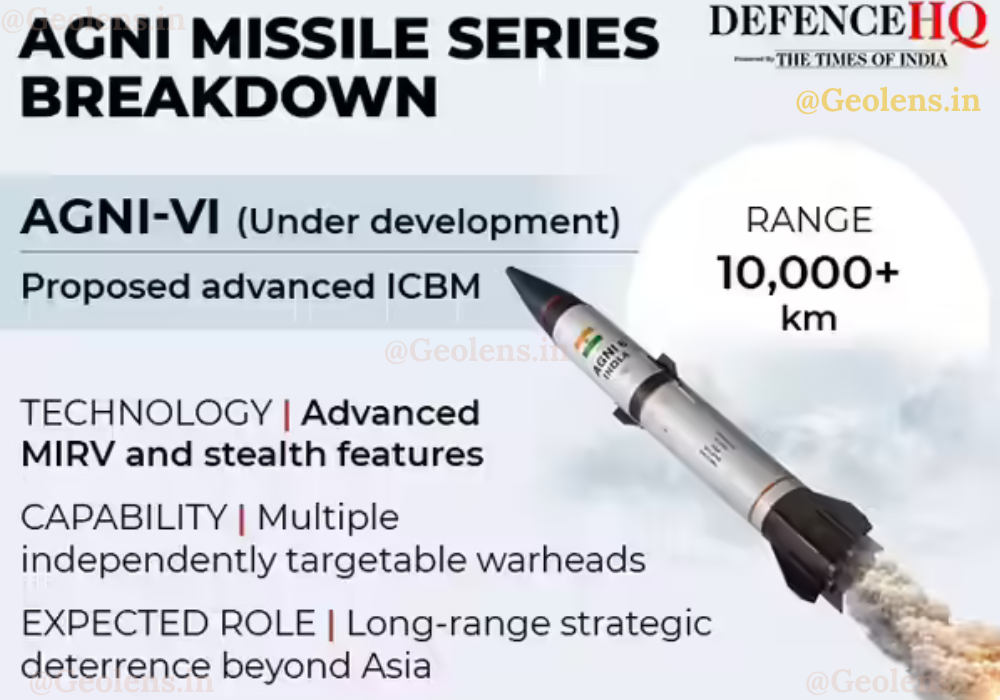
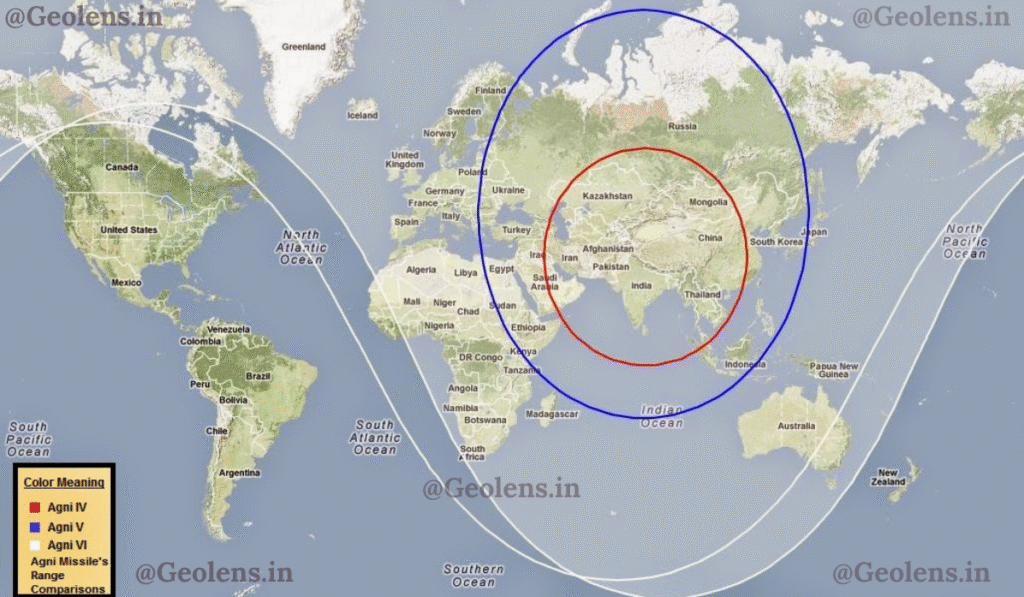
- Agni‑V introduced near-intercontinental reach and advanced survivability
Each step was deliberate, incremental, and aligned with India’s long-standing doctrine of credible minimum deterrence rather than arms race escalation.
Agni 6 is the logical continuation of this progression—yet it also marks a qualitative shift rather than just a quantitative one.
What Makes Agni 6 Different?
According to DRDO leadership, Agni 6 is envisaged as a next‑generation strategic missile, surpassing its predecessors in sophistication and adaptability. While specific design details remain classified—as they should—its conceptual role is becoming clear.
1. A New Class of Strategic Capability
Agni 6 is widely understood to be aimed at intercontinental-class performance, putting it in a different league from Agni‑V. This does not necessarily mean increased aggressiveness, but rather greater flexibility, reach, and survivability.
In modern deterrence theory, distance is not just about geography—it is about assured second‑strike capability, regardless of where threats emerge.
2. Enhanced Survivability and Penetration
One of the defining challenges of modern missile systems is defeating increasingly advanced missile defense networks. For deterrence to remain credible, strategic systems must be able to survive:
- Pre‑emptive strikes
- Surveillance and tracking
- Interception attempts
Agni 6 is expected to incorporate advancements that improve its ability to penetrate defensive shields. This does not automatically imply offensive escalation; rather, it ensures that deterrence remains effective in a world where missile defenses are proliferating.
3. Platform and Payload Flexibility
A recurring theme in DRDO’s recent statements is adaptability. India is increasingly designing missile systems that can be repurposed, modularized, or adapted across multiple platforms and missions.
Agni 6 is likely to reflect this philosophy, potentially allowing for future adjustments without redesigning the entire system. This approach reduces long‑term costs while enhancing strategic versatility.
Policy First, Technology Ready
One of the most important points reiterated by the DRDO Chairman is that Agni 6 is a policy decision, not a technological bottleneck. India’s scientists and engineers are ready; what remains is political authorization.
This distinction matters.
India’s missile development has never been driven by technological opportunism alone. Instead, each major step has followed:
- Strategic threat assessments
- Doctrinal reviews
- Geopolitical considerations
- Arms control obligations
Agni 6 will be no different. Its approval—or delay—will reflect India’s reading of the global security environment rather than mere technological ambition.
Agni 6 and India’s Nuclear Doctrine
India’s nuclear doctrine is built on three pillars:
- No First Use (NFU)
- Credible Minimum Deterrence
- Civilian Control over Strategic Forces
Agni 6 does not contradict any of these principles. In fact, it arguably reinforces them.
Strengthening Credibility Without Aggression
Deterrence works only when it is credible. As missile defense systems evolve and adversaries modernize their arsenals, older systems risk losing effectiveness. Developing Agni 6 ensures that India’s deterrent remains credible without expanding numbers indiscriminately.
This aligns perfectly with India’s preference for quality over quantity.
Second‑Strike Assurance
A cornerstone of stability is the assurance that no adversary can neutralize a nation’s retaliatory capability. Agni 6, combined with India’s triad (land, sea, air), strengthens second‑strike confidence, thereby reducing incentives for pre‑emptive actions.
Paradoxically, strong deterrence often makes conflict less likely.
The Broader Technological Ecosystem
Agni 6 does not exist in isolation. It is part of a larger ecosystem of research and development that includes:
- Advanced guidance systems
- Solid‑fuel propulsion technologies
- Command, control, and communication networks
- Space‑based tracking and early warning
Recent remarks by DRDO highlight progress in hypersonic technologies, including both glide vehicles and cruise missiles. While these are separate programmes, they contribute to an integrated strategic framework where multiple systems reinforce each other.
Agni 6 benefits from—and contributes to—this ecosystem.
Conventional and Strategic Roles: A Blurred Boundary?
Another interesting dimension emerging from DRDO’s commentary is the discussion around a conventional missile force. India is examining how different missile classes—ballistic, cruise, and hypersonic—can meet varying operational needs without over‑reliance on a single category.
While Agni 6 is firmly strategic in nature, lessons from its development could influence other domains, such as:
- Mobility and deployment concepts
- Rapid response frameworks
- Integration with intelligence and surveillance assets
Modern warfare increasingly blurs the lines between strategic and operational domains, and India’s missile roadmap reflects this reality.
Strategic Stability in Asia
Agni 6 will inevitably be viewed through the lens of regional and global power equations.
Deterrence, Not Domination
India’s missile advancements are often misunderstood as attempts at dominance. In reality, they are best understood as stability‑seeking measures in a region marked by:
- Unresolved border disputes
- Asymmetric military postures
- Rapid technological diffusion
By maintaining a survivable deterrent, India reduces the risk of coercion and miscalculation.
Also Read about- India Is Surrounded by Unstable Neighbours — What are the Real Challenges and Opportunities Does This Create?

Global Responsibilities
India has consistently projected itself as a responsible nuclear power, adhering to export controls, non‑proliferation norms, and restraint-based doctrines. Agni 6, if approved, will likely be developed and deployed within these established boundaries.
This approach strengthens India’s credibility not only as a military power, but also as a stabilizing global actor.
Why Agni 6 Matters Beyond Missiles
At its core, Agni 6 is not just about range or payloads—it is about strategic confidence.
- Confidence that deterrence remains intact
- Confidence that technological self‑reliance is achievable
- Confidence that policy, not panic, guides national security
In an era of rapidly shifting alliances and emerging technologies, such confidence is invaluable.
The Road Ahead
As of now, Agni 6 awaits formal governmental approval. When or if that approval comes will depend on strategic assessments rather than headlines.
What is clear, however, is that India has reached a point where choice, not constraint, defines its defence posture. The readiness of Agni 6 is a testament to decades of investment in science, engineering, and strategic planning.
Whether approved today or years from now, Agni 6 symbolizes India’s preparedness for the uncertainties of tomorrow.
Also read about- Types of Missiles in India
Author’s Viewpoint
India’s missile development story is not one of aggression, but of evolution — a steady pursuit of technological maturity guided by restraint and responsibility. The readiness for Agni 6 reflects a nation confident in its scientific capability and measured in its strategic choices. It is a reminder that credible deterrence is not built overnight; it is earned through decades of disciplined innovation and policy coherence.
Agni 6, therefore, is more than a missile — it is a statement of India’s intent to remain secure without being provocative, autonomous without being isolated, and forward‑looking without abandoning prudence. In a world where deterrence increasingly depends on precision, survivability, and adaptability, India’s approach stands out for its balance between power and principle.
Ultimately, the Agni 6 milestone symbolizes India’s transition from capability‑building to confidence‑building — a quiet assertion that strength and stability can coexist when guided by vision rather than velocity.
Conclusion
Agni 6 stands as a marker of maturity rather than militarism. It reflects an India that understands power not as an end in itself, but as a means to preserve peace, autonomy, and stability. In declaring readiness for Agni 6, DRDO has sent a clear message: the technology is ready, the capability is real, and the decision—wisely—rests with policy.
In the final analysis, Agni 6 is less about what India can do, and more about ensuring it never has to.



US House Passes Massive $1.15 Trillion Defense Bill: What It Means for America, China, India, and the World
The United States House of Representatives has approved a historic $1.15 trillion Defense Bill ,…

China’s Warning and Nuclear Tensions in the Russia Ukraine War

What`s Happening in POK, Why POK protestors ask India for help in 2026
In a striking turn of events, Their plea—POK protestors ask India for help—is more than…

India Declares 23 Individuals as Terrorists: A New Chapter in Counterterrorism
Introduction India Declares 23 Individuals as Terrorists under the Unlawful Activities (Prevention) Act (UAPA),…

52000 Crore Defence Deal: Defence Acquisition Council Approves
India has taken another major step towards strengthening its armed forces and accelerating defence…

US Dollar Bypassing? India Japan Local Currency Trade: How Yen-Rupee Settlement Can Reduce Costs and Transform Bilateral Commerce
India and Japan are exploring a groundbreaking: India Japan Local Currency Trade framework that…

SECOND NATURAL GAS DISCOVERY IN ANDAMAN: India’s Energy Future Takes a New Turn
The second natural gas discovery in Andaman by Oil India Limited (OIL) has created…
General NS Raja Subramani as New CDS and Admiral Krishna Swaminathan as New Navy Chief 2026
New CDS & New Navy Chief : On Sunday, India experienced a major shift…
Agni 6: India’s Gateway to the Next Era of Strategic Deterrence

US to Leave Iran: What It Means for the War and the World
The announcement that the US to leave Iran “very soon” has sent shockwaves across…

Almost 8.5 million Joins : “No king Protest in USA” against Trump

“Will shoot first, ask questions later.” Why Trump wants Greenland and why it is so important ? In 2026

Operation Absolute Resolve: How the U.S. Capture of Nicolás Maduro Reshaped Global Geopolitics

India Is Surrounded by Unstable Neighbours — What are the Real Challenges and Opportunities Does This Create?