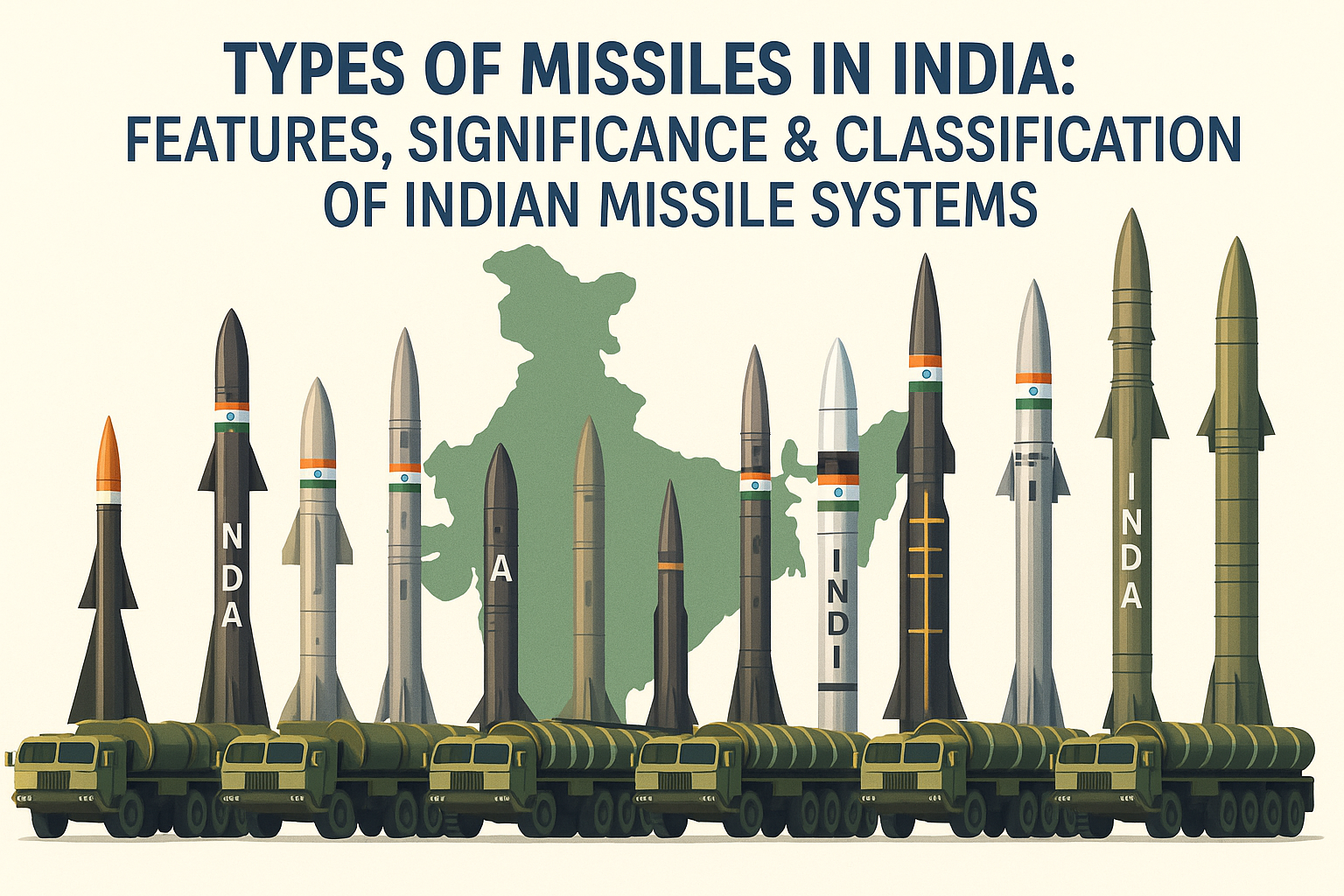


Types of Missiles have become the “New Swords” in modern warfare. These high-tech weapons can change the course of a war in minutes, and India is rapidly building and upgrading its missile arsenals. As in running times, wars are no longer just about soldiers fighting on the ground. They are about precision, speed, and long-range power.
Table of Contents
Upgradation and Development of Ballistic and Cruise missile system is the need of a hour, the development of such missiles comes to the existence post-independence, under the IGMDP (Integrated Guided Missile Development Program) under this program India moves strategically to maintain the balance of power, peace and strategical importance in the Indo-Pacific region.
What is a Missile?
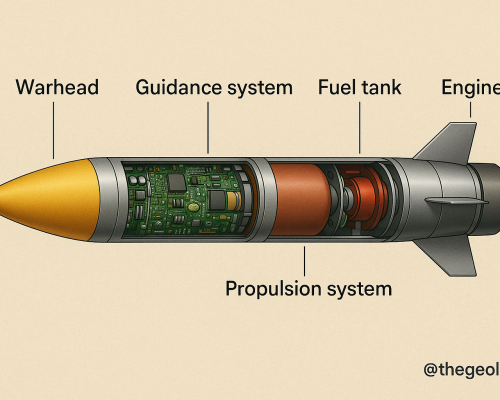
A missile is a guided weapon designed to deliver a payload (like explosives or nuclear warheads) to a specific target. Unlike bullets or bombs. Missiles can change direction mid-air, travel hundreds or thousands of kilometers, and hit targets with incredible accuracy. Having either a Jet Engine or rocket engine. Missiles have 5 major components’ namely:
* Warhead
* Guidance system
* Fuel tank
* Propulsion system
* Engine
Features of Indian Missile System
India’s missile development program is managed primarily by the Defense Research and Development Organization (DRDO). With the primary focus on the following key features:
Indigenous Technology: Most of India’s missile systems are developed indigenously. Which are suitable according to the India`s need and geological importance and sustainability
Strategic Deterrence: Nuclear-capable missiles serve as a deterrent against hostile nations.
Multi-platform Launch Capability: Missiles can be launched from land, sea, and air.
Modern Guidance Systems: Incorporates GPS, inertial navigation, and terrain-matching tech.
Speed & Precision: Supersonic and hypersonic capabilities with high accuracy.
Significance of Types of missiles system
In the rapid changing global security landscape, missiles have gained strategic importance and become one of the most unparallel defense assets for any nation. Their significance goes far beyond battlefield use, they decide foreign policy and technological superiority. Here’s why missiles are so significant today:
1. Strategic Deterrence: Missiles, especially nuclear-capable ballistic missiles, serve as a powerful deterrent against potential enemies. Countries like India maintain a strong missile force to prevent aggression from nuclear-armed adversaries like China and Pakistan. The mere possession of long-range missiles like Agni-V can discourage hostile actions.
2. Precision Warfare: Modern warfare demands high-precision, low-casualty operations. Missiles like BrahMos and Astra allow for targeted strikes on enemy bases, command centers, and infrastructure with minimal collateral damage. This is crucial in both counterterrorism and conventional operations.
3. Rapid Response Capability: Missiles offer a quick reaction option during times of war or emergency. They can be launched within no time from land, sea, or air, protecting nations from a potential threat and helping a flexible and scalable military response without risking life/ unmanned aircraft or troops.
4. A2/AD Zones: In Indo-Pacific region, where freedom of navigation is contested, missiles play a vital role in Anti-Access/Area Denial (A2/AD) strategies. India’s growing missile arsenal helps in protecting its maritime interests & deter hostile navies in the Indian Ocean and South China Sea.
5. Prestage & Technological advancement: Countries with advanced missile systems are seen as technological powerhouses. Indigenous missile programs boost national pride, self-reliance, and global influence. India’s successful missile tests and exports (like BrahMos to the Philippines) showcase its growing global stature.
6. Effective Counter-Terrorism Tool: Precision missile strikes are instrumental in surgical strikes, as seen in India’s Balakot airstrike (2019), Operation Sindoor (2025). Missiles help neutralize high-value terror targets in enemy territory while minimizing the risk to military personnel.
7. Future Readiness: Hypersonic & AI- Monitor Missiles: As warfare becomes more tech-focused, and missiles are evolving rapidly with hypersonic speeds, AI-based navigation, and swarm technology. Nations investing in next-gen missile systems are more likely to dominate future conflicts.
Now you must be wondering what a Jet Engine and a Rocket Engine is. A jet engine is something that needs air from the atmosphere to work, while a rocket engine carries its own oxygen and can work even in space.
Jet Engine vs Rocket Engine: Key Differences
| Feature | Jet Engine | Rocket Engine |
|---|---|---|
| Oxygen Source | Takes oxygen from the air | Carries its own oxygen |
| Functionality in Space | Does not work in space | Works in space |
| Speed | Generally slow | Extremely fast (can reach space) |
| Main Usage | Aircraft (planes, jets) | Rockets, missiles, spacecraft |
| Fuel Efficiency | More fuel-efficient in atmosphere | Less efficient, but very powerful |
Different Types of Missiles in India
India showcases a tremendous strength of capabilities & Military readiness by providing credible nuclear deterrence and stands with the peace as a symbol of its natural existence in the geopolitical era and makes a room for Nation comes first Policy.
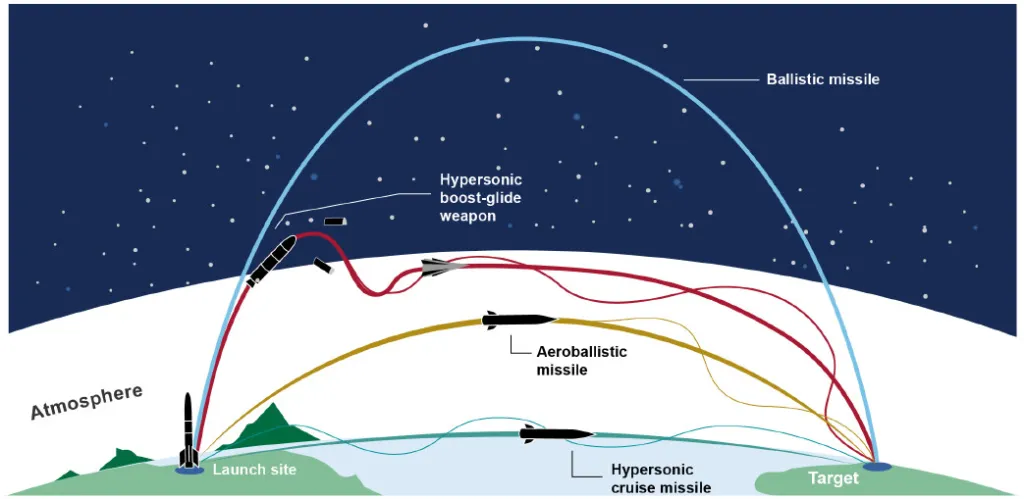
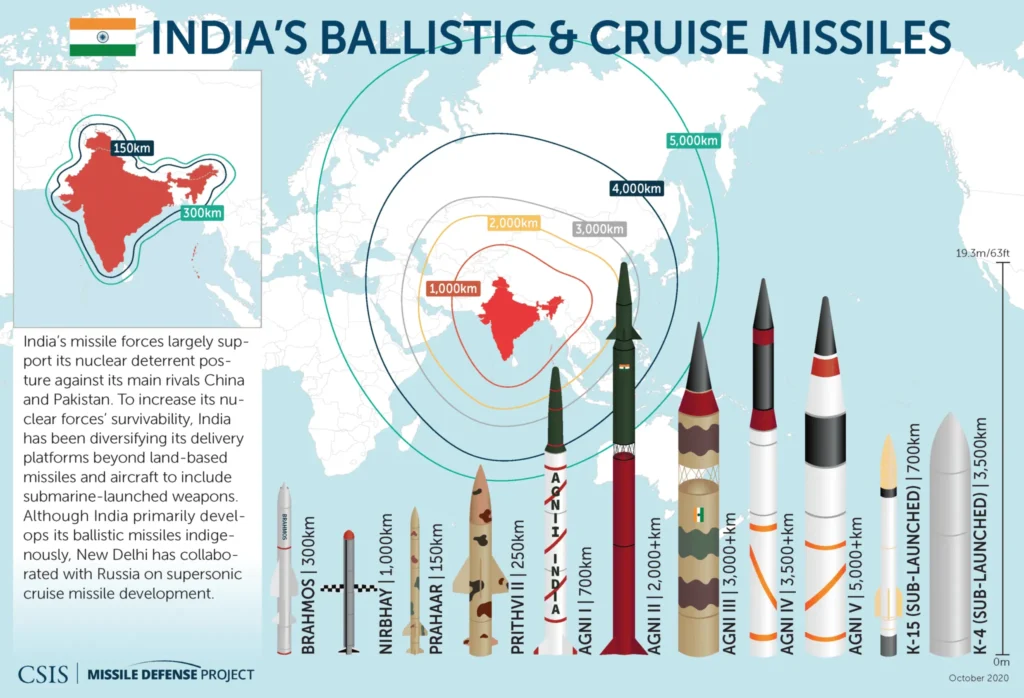
and it is mainly differentiated between 2 Types of missiles: Ballistic and Cruise missile.
Ballistic missiles are launched into the sky and follow a curved, high-arc path (like throwing a ball), traveling mostly outside the Earth’s atmosphere. They are powered only during the initial phase, after which they fall freely toward the target. These missiles are usually used for long-range strikes, including nuclear attacks, and can reach very high speeds, even hypersonic levels.
Eg:Agni series (Agni-5, Agni-P), Prithvi
Cruise missiles, on the other hand, fly like an aircraft at low altitudes throughout their journey. They are powered and guided for the entire flight, making them highly accurate. Cruise missiles are slower than ballistic ones but harder to detect due to their low flight path and are mainly used for precise strikes on tactical targets.
Eg:BrahMos, Nirbhay
Also read about – India’s Project 18 Destroyer: Armed with 144 Missiles including BrahMos with Surveillance Power up to 500 km
Classification of Types of Missiles
To understand the full capabilities of modern missile systems, it’s essential to classify them based on multiple characteristics. Below is a comprehensive classification types of missiles based on type, launch mode, range, propulsion, and guidance system, especially focusing on the types of missiles India have in its arsenal.
1. Classification on Types of Missiles Based on (Warhead Purpose)
| Type | Purpose | Indian Examples |
|---|---|---|
| Ballistic Missiles | Delivered in a high-arc trajectory, often nuclear | Agni series, Prithvi |
| Cruise Missiles | Fly at low altitudes, guided throughout flight | BrahMos, Nirbhay |
| Surface-to-Air Missiles (SAM) | Intercept incoming aerial threats | Akash |
| Air-to-Air Missiles | Fired from aircraft to destroy enemy aircraft | Astra |
| Anti-Tank Missiles | Target armored vehicles and tanks | Nag |
| Submarine-launched Missiles (SLBM) | Second-strike nuclear deterrence | K-15, K-4 |
2. Classification on Types of Missiles Based on Launch Mode
| Launch Platform | Description | Indian Examples |
|---|---|---|
| Surface-to-Surface (SSM) | Fired from ground to ground targets | Agni, Prithvi |
| Surface-to-Air (SAM) | Intercepts incoming aircraft/missiles | Akash, Barak-8 |
| Air-to-Air (AAM) | Fired from fighter jets | Astra, R-77 |
| Air-to-Surface (ASM) | Jet launches missile to strike ground/sea target | BrahMos-A |
| Submarine-to-Surface (SLBM) | Launched from submarine to land target | K-15, K-4 |
| Ship-to-Ship / Ship-to-Air | Naval missile strikes from warships | BrahMos-NG |
3. Classification on Types of Missiles Based on Range
| Range Type | Distance | Indian Examples |
|---|---|---|
| Short-Range Missiles (SRM) | Up to 500 km | Prithvi, Akash |
| Medium-Range Missiles (MRM) | 500 km to 1,000 km | Agni-I, Nirbhay |
| Intermediate-Range Missiles (IRM) | 1,000 km to 5,500 km | Agni-II, Agni-III |
| Intercontinental Ballistic Missiles (ICBM) | Above 5,500 km | Agni-V, under development |
| Tactical Missiles | For battlefield use (<300 km) | Nag, Helina |
| Strategic Missiles | For deterrence (>1,000 km) | Agni series, K-series |
4. Classification on Type of Missiles Based on Propulsion System
| Propulsion Type | Fuel Type | Description | Examples |
|---|---|---|---|
| Solid Propellant | Pre-mixed solid fuel | Quick launch, longer shelf life | Agni series, Akash |
| Liquid Propellant | Separate fuel and oxidizer | More control but longer preparation | Prithvi series |
| Dual Propellant | Combination of solid & liquid | Flexibility with efficiency | Some K-series SLBMs |
| Ramjet/Scramjet Engine | Air-breathing engine (Cruise) | Supersonic/hypersonic capability | BrahMos (Ramjet), HSTDV |
5. Classification on Type of Missiles Based on Guidance System
| Guidance Type | How it Works | Accuracy Level | Used In |
|---|---|---|---|
| Inertial Navigation System (INS) | Uses internal sensors like gyroscopes | Moderate | Agni, Prithvi |
| GPS/GLONASS Guided | Satellite navigation-based guidance | High | Nirbhay, BrahMos |
| Laser-Guided | Target illuminated by laser for precision hit | Very High | Anti-tank missiles (Nag) |
| Infrared/GPS Hybrid | Heat-seeking or infrared image processing | High | Astra |
| Radar-Guided | Active or passive radar homing | High | Akash, Barak-8 |
India's role in Indo Pacific region
India’s missile strength is a central pillar in shaping the Indo-Pacific security architecture:
Countering China’s Aggression: Missile deployments from Arunachal Pradesh to Ladakh keeping a core eye on Chinese incursions
Strategic Partnerships: QUAD nations rely on India’s strategic reach
Missile Diplomacy: BrahMos export to Philippines, Vietnam, and potential future deals with ASEAN nations
India’s missile capability is crucial for regional balance and ensuring freedom of navigation in the Indo-Pacific.
Missile man and missile women of India.
Sir Dr. A.P.J. Abdul Kalam – Known as the Missile Man of India, he was the brain behind Agni and Prithvi projects and later became the President of India.
Ma`am Dr. Tessy Thomas – Popularly called the Missile Woman of India, she was the Project Director of Agni-IV and India’s first woman to lead a missile project.
Their contributions symbolize India’s journey from dependency to defense self-reliance
Conclusion
India’s missile system is not just a tool of war, it is a symbol of national strength, technological innovation, and strategic vision. As regional tensions mount and the global power axis shifts, India’s missile capabilities will continue to play a pivotal role in maintaining peace and asserting sovereignty.
By understanding the different types of missiles, the features of Indian missile systems, and their geopolitical relevance, we get a clearer picture of India’s preparedness in an uncertain world.
And also find out why red sea is a war zone in 2025.
FAQs on Types of missiles
- What is a missile?
A missile is a guided weapon that can change direction mid-flight, travel long distances, and strike targets with high accuracy using advanced guidance systems. - Why are missile systems important for India?
They strengthen national security, provide deterrence against hostile neighbours, support precision strikes, and enhance India’s strategic influence in the region. - What are the main types of missiles in India?
India develops ballistic missiles and cruise missiles, along with multiple subcategories based on range, guidance, propulsion, and launch platforms. - How are Indian missiles classified by range?
They are classified as short-range, medium-range, intermediate-range, and intercontinental ballistic missiles, depending on how far they can travel. - What is the difference between ballistic and cruise missiles?
Ballistic missiles follow a high-arc trajectory outside much of the atmosphere, while cruise missiles fly at low altitude throughout the flight for high precision.
People Also Ask (PPA) on Types of missiles
- Which are India’s primary ballistic missile systems?
India’s ballistic arsenal includes the Agni series for long-range strategic capability and the Prithvi series for short-range tactical operations. - Does India have nuclear-capable missiles?
Yes. Multiple systems like Agni and Prithvi variants are designed to deliver nuclear warheads as part of India’s strategic deterrence. - What guidance systems are used in Indian missiles?
India uses inertial navigation systems, satellite-based guidance, radar homing, infrared seekers, and hybrid multi-sensor guidance for higher accuracy. - What propulsion technologies power Indian missiles?
Solid-fuel, liquid-fuel, and air-breathing propulsion systems (like ramjets and scramjets) are used depending on speed, mission type, and missile class. - Which missiles support India’s second-strike capability?
Submarine-launched ballistic missiles in the K-series strengthen India’s nuclear second-strike credibility and maritime deterrence posture.
Kargil Vijay Diwas 2025: Honoring the Valor of India’s Bravehearts|26th July 1999
|The GeoLens – Indian Defense & Global Affairs
Pratik Kondawale
Strategist | Indian Defence & Global Affairs
Founder of GeoLens.in, Pratik writes in-depth analysis on India’s defence strategy, military tech, and global power shifts delivering sharp insights through an Indian lens.

China’s Warning and Nuclear Tensions in the Russia Ukraine War
The Russia Ukraine War has become one of the most defining conflicts of the 21st century, reshaping global geopolitics, economics, and security. What began as a territorial dispute in February 2022 has evolved into a prolonged war with far‑reaching consequences. Recently, China issued a rare and direct warning to Russia, urging it not to use nuclear weapons in Ukraine. This development highlights the seriousness of the situation and the growing fear of escalation beyond conventional warfare.

What`s Happening in POK, Why POK protestors ask India for help in 2026
In a striking turn of events, Their plea—POK protestors ask India for help—is more than a humanitarian request; a viral video from Pakistan‑occupied Kashmir (POK)

India Declares 23 Individuals as Terrorists: A New Chapter in Counterterrorism
Introduction India Declares 23 Individuals as Terrorists under the Unlawful Activities (Prevention) Act (UAPA), marking a significant escalation in its fight against cross‑border militancy. This

52000 Crore Defence Deal: Defence Acquisition Council Approves
India has taken another major step towards strengthening its armed forces and accelerating defence modernization. The Defence Acquisition Council (DAC), chaired by Defence Minister Rajnath

US Dollar Bypassing? India Japan Local Currency Trade: How Yen-Rupee Settlement Can Reduce Costs and Transform Bilateral Commerce
India and Japan are exploring a groundbreaking: India Japan Local Currency Trade framework that would enable direct settlements in yen and rupees, reducing reliance on

SECOND NATURAL GAS DISCOVERY IN ANDAMAN: India’s Energy Future Takes a New Turn
The second natural gas discovery in Andaman by Oil India Limited (OIL) has created waves in India’s energy sector. This breakthrough is not just about
8 thoughts on “Types of Missiles in India: Features, Significance & Classification of Indian Missile Systems 2025”